


Posted on: March 20, 2026, 03:15h.
Last updated on: March 20, 2026, 03:15h.

- The current federal tax on sports betting is only 0.25%
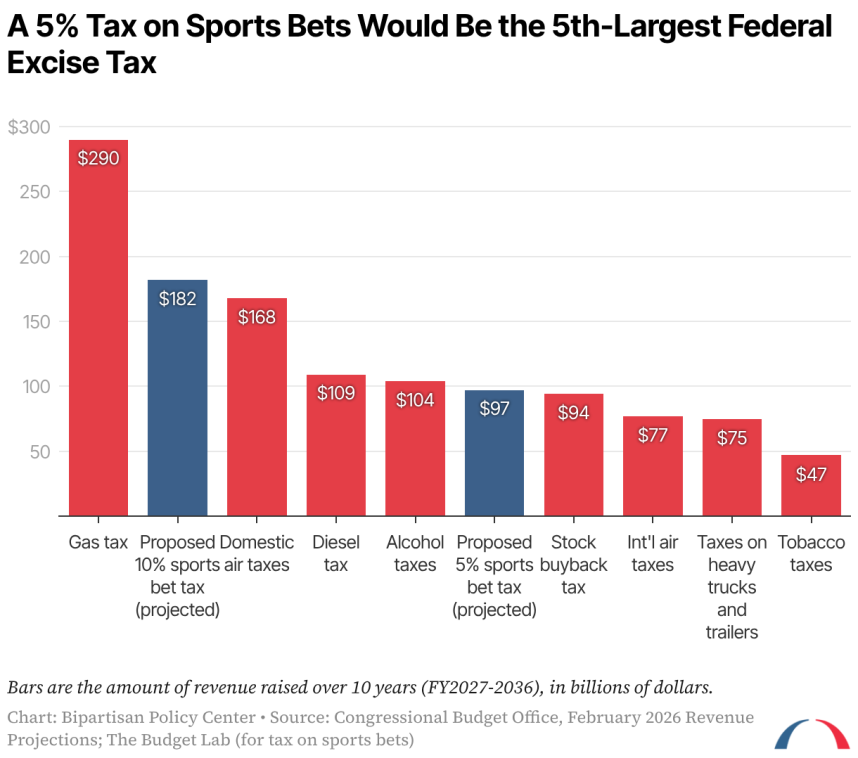
- If increased to 5%, it could generate a staggering $97 billion in revenue over a decade
- At 5%, it would rank as the fifth-largest federal excise tax
As several states are increasing their sports betting taxes or contemplating similar actions, it might be the right moment for federal authorities to take similar steps.
At present, the federal excise tax on sports betting stands at a mere 0.25%. According to the Bipartisan Policy Center, increasing this rate to 5% could raise about $97 billion over ten years, making it the fifth-largest federal excise tax. If the tax rate rises to 10%, it could generate an astonishing $182 billion in the same period.
The policy analyst group asserts that if Congress raises the federal sports betting tax to 5%, the annual number of bets placed may decline by approximately 4%. Should a more aggressive 10% tax be executed, the number of placed wagers could drop by roughly 10%.
Some states that have raised sports wagering taxes have seen reductions in the total number of wagers, yet no significant drop in overall handle or tax revenue. This suggests that while bettors might wager less frequently, they compensate for this by increasing the size of their bets.
The Federal Sports Betting Tax Misses Out on Growth Opportunities
Since the Supreme Court’s 2018 decision regarding the Professional and Amateur Sports Protection Act (PAPSA), the amount wagered on regulated sports betting in the U.S. has soared nearly 24-fold, yet federal tax policy has not kept pace and has actually diminished over recent decades.
“In 1974, Congress reduced the tax rate on legal wagers from 10% to 2%, and further down to 0.25% in 1982. The 1982 law also introduced a separate 2% tax on illegal bets. This 0.25% rate for legal wagers has remained unchanged ever since,” notes the Bipartisan Policy Center.
The policy center also highlights that a federal per-bet tax of five cents would yield far less revenue than a straightforward 5% tax.
“This option is projected to bring in only $1.3 billion from FY2027-2036, significantly overshadowed by the potential revenue from a 5% tax. However, in the long run, its impact might be more pronounced, as gamblers may place fewer higher-value wagers to mitigate the tax’s effects under this alternative,” the Center notes.
Revenue Growth Even with Taxpayer Adjustments
Illinois serves as a key example of how bettors respond to tax increases. Last year, the state introduced a $0.25 tax per bet on the first 20 million bets, which escalates to $0.50 for bets beyond that threshold.
This cost has been transferred to consumers via transaction fees (seen with platforms like DraftKings, Fanatics, and FanDuel) or through increased minimum bet requirements by various operators. Recent data suggests that while the number of bets in Illinois has decreased, the total handle remains stable. According to the Bipartisan Policy Center, even if bettors react negatively to a 5% federal tax, the government would still gain significant revenue.
“Even with a substantial reaction from bettors—such as an elasticity of -3 instead of -0.5, translating to a 3% decrease in sports betting volume for every 1% hike in after-tax prices—tens of billions of dollars in revenue could still be generated over the next decade,” the organization emphasizes.