


Published on: October 3, 2025, 05:52h.
Updated on: October 3, 2025, 05:52h.

The projected expenses for Brightline West’s high-speed rail line that will link Southern California to Las Vegas have escalated to $21.5 billion. This marks a significant increase from the previous estimate of $12.4 billion reported in January 2025. The revised number was released in a report by the U.S. Department of Transportation (DOT) this week.
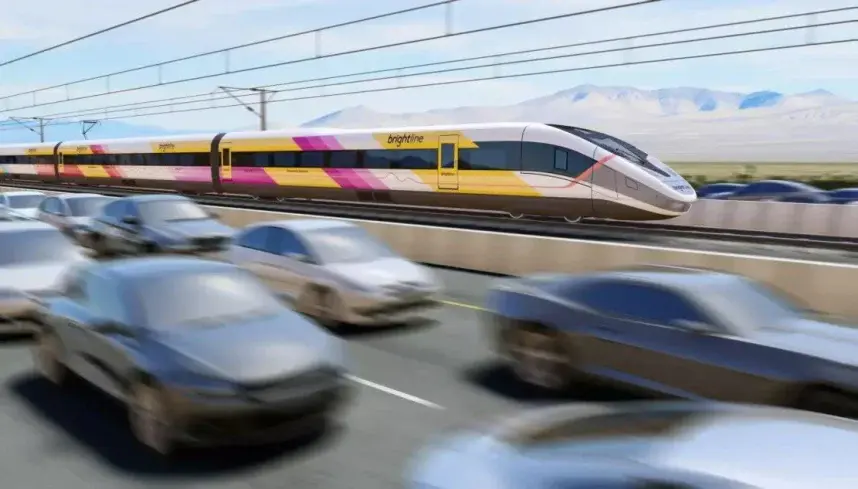
As reported by Bloomberg, the significant cost hike is mainly attributed to increasing labor and material expenses. In reaction, Brightline West is pursuing a $6 billion federal loan from the Trump administration to substitute a previously anticipated $6 billion bank facility.
The company also plans to seek additional equity financing to manage the remaining cost increases.
“We have had very constructive discussions with USDOT and the Federal Railroad Administration recently to propel Brightline West forward,” stated Brightline CEO Mike Reininger in a September interview with Bloomberg.
Previously, Brightline West secured a $3 billion federal grant under the Biden administration, structured as reimbursement based on meeting minimum spending thresholds.
Will Trump Impede Progress?
The potential for federal funding for Brightline West is now in doubt as there are wider reductions to high-speed rail projects.
Earlier this year, the Trump administration terminated a $64 million planning grant for a proposed Dallas–Houston rail line. In August, it retracted $4 billion in federal funding for California’s Los Angeles–San Francisco high-speed rail project, whose cost has escalated from $33 billion in 2008 to an estimated $128 billion.
Despite these challenges, Brightline West seems to be maintaining its momentum, primarily due to its predominantly private financing structure.
“We are thrilled to be the only high-speed rail initiative currently backed by the Trump administration,” Reininger remarked to Bloomberg.
The Long Wait Ahead
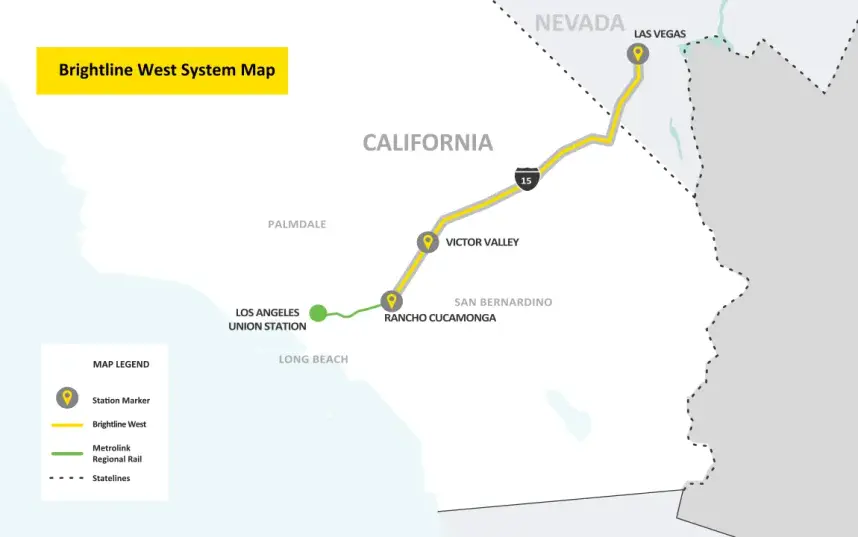
In September 2018, Brightline disclosed its acquisition of the older XpressWest high-speed rail project, which was previously authorized to construct a rail line connecting Las Vegas to Los Angeles.
By 2020, projected construction expenses were pegged at $8 billion. This was later adjusted to $10 billion in mid-2023. During a bond offering in January 2025, the costs were revised to $12.4 billion.
The most recent unannounced estimate reached $16 billion, according to the DOT.
Construction officially began in April 2024 following a groundbreaking event, although only preliminary field investigations and utility installations have been executed thus far.
The Las Vegas terminal will be built by McCarthy Building Co. on Las Vegas Boulevard, close to Blue Diamond Road. While this location is 2.5 miles from the Las Vegas Strip, ride-hailing services, resort shuttles, and car rental options will be available at the station.
The Southern California station will drop off passengers in Rancho Cucamonga, where light rail links will transport them an additional 37 miles southwest to downtown Los Angeles, which should take about an hour for most travelers.
Brightline West has now abandoned its initial ambition to commence operations before the 2028 Summer Olympics in Los Angeles, confirming that services will not be available until at least December 2028.