


Date of Publication: December 15, 2025, 07:21h.
Updated on: December 14, 2025, 07:14h.

Despite our best efforts, complete success isn’t always within reach. While we confidently dismiss many recurring tales from Las Vegas as exaggerated, proving them wrong isn’t always straightforward. Just last month, we had to eat our words after declaring that mobster Bugsy Siegel’s Flamingo escape tunnel was merely a Vegas myth, only to be confronted with photographic proof mere hours after our article was published!
With your assistance, perhaps we can debunk some of these intriguing Vegas myths this year.
Do Casinos Utilize Scents to Encourage Gambling?
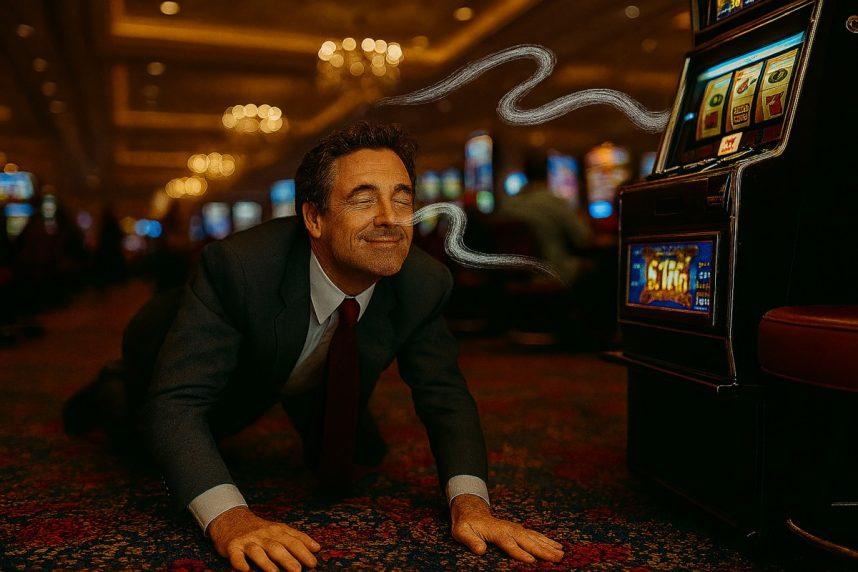
In October of 1991, Dr. Alan Hirsch, a neurologist, introduced two pleasant scents into designated slot machine areas at the Las Vegas Hilton. One aroma encapsulated 18 machines, while another 28 machines were surrounded by the second scent, leaving a third area with 22 machines unscented as a control.
The outcome? Gamblers inserted 45.11% more money into the machines enveloped by the first scent than during similar weekends before and after. The second scent and control zone showed no significant changes.
Hirsch attributed this to nostalgia triggered by smell, arguing that the scent subtly influenced mood and behavior. (To this day, he remains tight-lipped about the exact scent after a prior study led to a fragrance company falsely claiming credit and threatening legal action.)

Upon the peer-review and publication of Hirsch’s study in the journal Psychology & Marketing in October 1995, he forecasted that scent-based behavioral influence would become as routine in casinos as artificial jackpot sounds.
Has it? No one can provide a clear answer — or will provide one. When discussing the scents pumped through their ventilation systems, casinos focus on guest experience and brand atmosphere, rarely mentioning behavioral influence.
When we inquired directly with Hirsch, he remarked: “I cannot confirm it’s actively happening right now.” Yet, he acknowledged consulting with multiple Las Vegas casinos, none of which he was prepared to disclose.
While casinos might attempt to shape gambling habits, the success of these efforts remains uncertain. In the gaming world, even minute behavioral assertions attract regulator attention — and casinos are scrutinized for payout ratios, machine placements, and advertising language.
If scents were effectively utilized to promote addiction, we would anticipate whistleblowers, legal actions, and concerns raised by responsible gaming advocates, consumer watchdogs, and liability lawyers.
So far, none of this has materialized. In fact, in the three decades since Hirsch’s study, it has yet to be replicated, and the entire topic appears surprisingly neglected.
While we believe claims of odor-driven manipulation lack substantiation, we are left with mere conjecture, not the solid evidence needed to debunk a myth.
Did Bugsy Siegel Have Lena Horne’s Linens Destroyed?

During her performances at the Flamingo from January 9-21, 1947, Lena Horne became the first Black artist known to stay on the Las Vegas Strip.
This unique arrangement — a condition set by Horne’s management — involved stipulations that were kept confidential.
“Horne’s stay in Las Vegas in early 1947 was largely solitary,” states the manuscript “Black Entertainers in Las Vegas in the Era of Segregation 1940-1960” by Roosevelt Fitzgerald, archived at UNLV.
“Confined from public hotel/casino areas, avoiding local establishments on the west side, and faced with segregated cinemas while questioning which venues would welcome her, she spent non-performance hours in the hotel-provided bungalow.”
However, there’s no credible evidence suggesting that owner Benjamin “Bugsy” Siegel mandated housekeeping staff to incinerate the singer’s bedsheets daily or at any point.
This narrative — first introduced in the 1991 KNPR documentary “Las Vegas: Mississippi of the West or Promised Land?” by historian William Drummond — lacks corroboration from FBI documents, legal records, Horne’s 1965 autobiography, or other reliable sources.
Unfortunately, Siegel left no personal letters, journals, or recorded dialogues. Nevertheless, observations can be made…
Among the vast collection of FBI documents, wiretap records, and informant reports pertaining to Siegel, no derogatory racial epithets or overtly racist remarks are attributed to him. (In contrast, many of his contemporaries, such as Mickey Cohen, frequently used derogatory terms in wiretapped discussions.)
Conversely, there’s no reliable evidence disproving this story either. So, while we are quite inclined to consider this a myth, until further evidence comes to light, we must maintain an open position.
Join us next Monday for the conclusion of this two-part series.
Look for the “Vegas Myths Busted” series every Monday on Casino.org. Visit VegasMythsBusted.com for previously debunked Vegas myths. Have a myth suggestion that needs exploring? Email [email protected].