


Published on: April 27, 2026, 11:18 AM.
Updated on: April 27, 2026, 11:18 AM.

As the aging Las Vegas Monorail prepares for its farewell, plans are underway to transform its tracks into elevated roadways for Elon Musk’s Vegas Loop. This innovative transit solution will allow Tesla vehicles to transition from underground tunnels to an elevated system, effectively bypassing traffic from the MGM Grand to the Sahara.
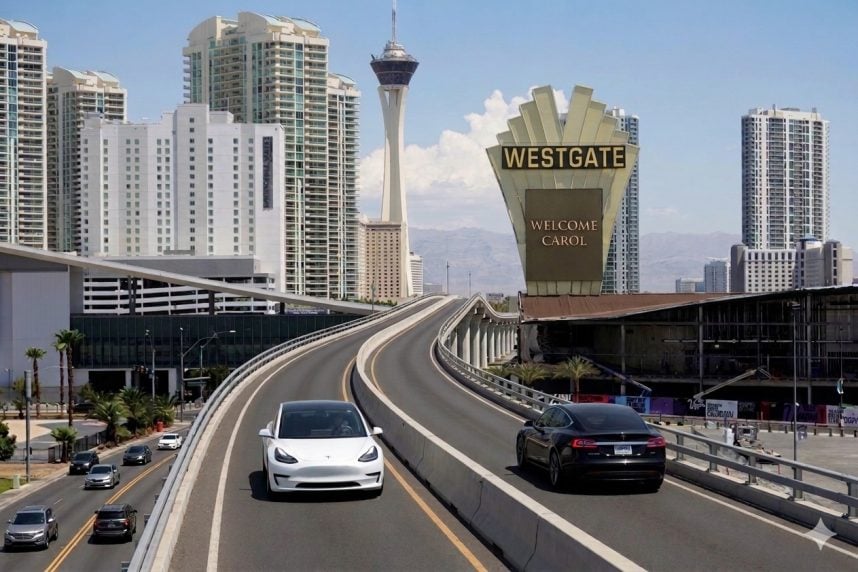
These developments have been on the horizon for approximately a year. Last week, Steve Hill, CEO of the Las Vegas Convention and Visitors Authority (LVCVA), which acquired the monorail in 2020, provided a detailed vision of the transition.
“The plan will involve the monorail,” he stated during an address to the Southern Nevada Home Builders Association (NHBA), as reported by Las Vegas Advisor. “We’re going to remove the track and install a pre-cast two-lane roadway above it, integrating it into the Boring Company’s network, while utilizing the current monorail stations.”
Initially, in 2020, the LVCVA indicated that the monorail would cease operations and be decommissioned by 2028, but that deadline has now shifted to between 2033 and 2035.
Conclusion for the Monorail
The Las Vegas Monorail has been a prominent feature along the resort corridor for nearly two decades. However, according to Hill, its operational lifespan is nearing its end. Operating the monorail has become as problematic as maintaining a vintage 1961 Ferrari 250 GT California SWB Spider; eventually, vital components become unreachable.
The monorail comprises nine Innovia 200 trams, customized for its track layout. These trams, produced by Bombardier in Quebec, are no longer manufactured. After accumulating substantial debt, Bombardier divested its rail division to Alstom in 2021 for $6.7 billion.
Alstom now supplies only the newer Innovia 300 model, which is incompatible with the original Innovia 200 due to its wider beam width.
For some time, monorail leaders had hoped that Disney World would upgrade its Mark VI trams, making retired units available for purchase. Interestingly, the initial monorail that serviced Las Vegas connected the MGM Grand and Bally’s using retired Disney World Mark IVs from 1995 to 2002.
Nonetheless, Disney faces the same impasse as Las Vegas. While it could invest in a new monorail system, it would require creating entirely new tracks. Although developing a monorail compatible with existing tracks is theoretically feasible, interest in this niche project remains low.
Caution Ahead
So, what prompted the LVCVA to invest $24.3 million in December 2020 for a transport system facing a gloomy future—especially when it had to pay a California-based company nearly $500K yearly for operation?
This decision stemmed from a noncompete clause associated with the monorail, which barred any alternate off-street transport system from being built along the Strip. The LVCVA had already entered into a $48 million agreement with Elon Musk’s Boring Company in 2019 to develop the Vegas Loop, a project that could have breached the monorail’s noncompete stipulations.
Path Forward
Instead of tearing down the elevated guideway, Hill envisions reusing the monorail’s infrastructure and support columns within the Vegas Loop.
This approach eliminates the necessity for the Boring Company to construct a separate four-mile tunnel connecting the South and North Strips along Las Vegas Boulevard.