


Published on: May 18, 2026, 07:10h.
Updated on: May 18, 2026, 07:10h.

A long-standing myth about Las Vegas has been circulating online for years: the claim that the pedestrian bridges along the Strip were designed to guide tourists into the casinos.
The story goes that casino owners in the mid-1990s pressured Clark County to remove street-level crosswalks to push visitors onto elevated walkways that lead directly to gaming areas.
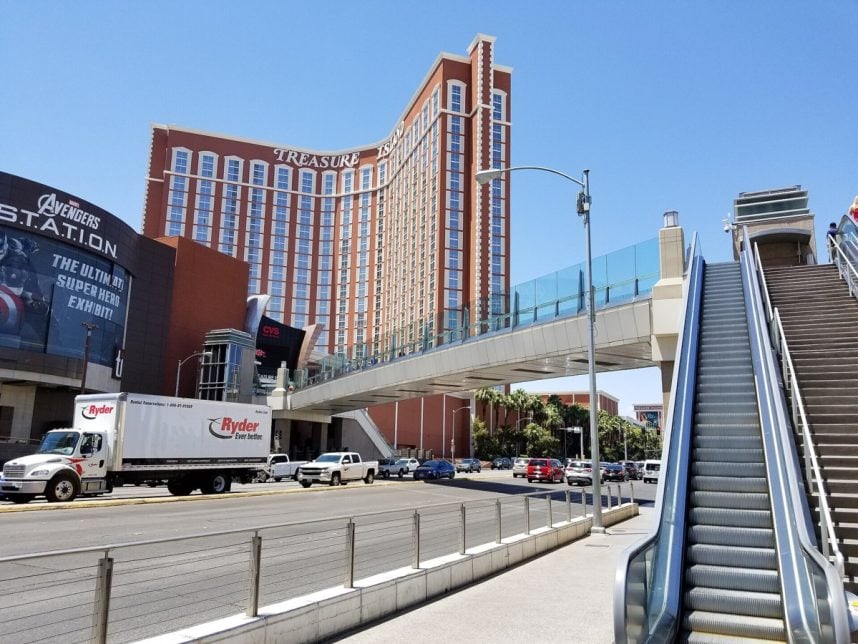
This myth, or at least a distorted version of it, was echoed in comments on a recent Casino.org article discussing the frequent malfunctioning of escalators on the Strip.
In response to the well-supported argument that escalator downtime is due to a shortage of specific parts, one commenter argued: “Nonsense. Parts are readily available. The casinos prefer to reroute foot traffic around slot machines and into their gaming areas!!”
Understanding the Myth
Currently, the only legal method to navigate the busiest intersections on the Las Vegas Strip is via pedestrian bridges. Upon arriving at any of these crossings, the first sight you’ll encounter on the opposite side is an entrance to a second-floor casino:
- Tropicana Avenue: MGM Grand, New York-New York, Excalibur
- Flamingo Road: Caesars Palace, Horseshoe, Bellagio
- Harmon Avenue: Cosmopolitan and Planet Hollywood
- Spring Mountain: Treasure Island and Venetian
However, you’ll also discover a set of stairs, elevators, and escalators that lead directly to the public sidewalks on the other side of the Strip. Entering a casino is not necessary unless there are mobility challenges and one or both elevators are out of service.
Crucially, everything at ground level on the Strip is conveniently located near a casino entrance!
The Reality of the Bridges
The primary purpose of the bridges was to enhance pedestrian safety, not to direct visitors into gambling establishments. By the 1990s, traffic was escalating, and the Las Vegas Strip had emerged as one of the most perilous areas for pedestrians in the United States.
Records from the Nevada Department of Transportation covering the five years prior to the bridge construction (1989-1994) reveal over a dozen fatalities and hundreds of serious injuries at the intersections of Flamingo, Tropicana, and Spring Mountain.
Clark County engineers deemed elevated walkways as the only effective long-term solution to the rising danger at traditional crosswalks.
Contrary to the legend, several prominent resorts, such as the MGM Grand, Venetian, and Wynn, opposed the construction of the bridges. Public pedestrian pathways undermined their claims that their sidewalks were private property, effectively preventing them from blocking union protests on those grounds.
Minutes from internal county meetings from the 1990s indicate concerns from casinos about how the bridges would influence valet service, visibility, and traffic flow. Some casinos feared that elevated pathways would actually deter pedestrians from their entrances instead of attracting them.
Despite these objections, the county proceeded, highlighting public safety as a priority. The 9th Circuit Court of Appeals later upheld that the bridges constituted public forums.
Nowadays, the bridges facilitate the safe passage of tens of thousands of individuals daily, particularly during significant events. They are widely regarded as a success story in terms of public safety.
Catch “Vegas Myths Busted” every Monday on Casino.org. Visit VegasMythsBusted.com to explore previously debunked Vegas myths. Have a suggestion for a Vegas myth that needs addressing? Reach out at [email protected].