


Published on: June 15, 2026, 07:21h.
Updated on: June 14, 2026, 04:17h.

For many years, a dismal legend has persisted about Las Vegas — that Clark County is the leading suicide hotspot in the U.S. The narrative often centers around hopeless gamblers, depleted finances, and erratic decisions melding in an environment rife with despair.
Yet, this assertion falters when we examine the actual statistics. Clark County has never recorded the highest suicide rate in America. It hasn’t even claimed that title in Nevada.

Understanding the Myth
This misconception emerges from a misinterpretation of public health statistics, a phenomenon known as “suicide tourism,” and the distinct pattern created by 40 million annual visitors that disrupt standard statistical analyses.
The misunderstanding begins with the contrast between raw numbers and per-capita rates. With a population of 2.3 million, Clark County logs around 350–400 suicides yearly. To a casual observer, this may seem alarming.
However, epidemiologists utilize age-adjusted rates per 100,000 residents, a fairer approach to evaluating a bustling metro area versus a rural county with only 7,000 residents.
In this regard, Clark County typically reports around 16–17 suicides per 100,000 individuals. While concerning and above the national average of approximately 14, it does not rank among the highest in the United States.
The Real Suicide Capital
To uncover the true epicenter of America’s suicide crisis, one must focus on rural counties. These areas often exhibit extreme isolation, limited mental health services, stagnant economies, and high firearm access.
Due to CDC privacy guidelines, data for counties reporting fewer than 10 annual deaths is not disclosed, preventing any county from being definitively labeled as the suicide capital for a specific year. Nonetheless, multi-year data from the CDC indicate that the Northwest Arctic Borough in Alaska possesses the highest sustained rate in the U.S., averaging an incredible 68-72.5 deaths per 100,000 residents, which is five times the national average. However, with a population of just 7,500, this rate translates to about 5-8 suicides each year.
Within the contiguous U.S., the highest rates consistently arise from:
- San Juan County, New Mexico
- Meagher County, Montana
- Nye County, Nevada(a neighbor to Vegas)
These counties frequently report suicide rates between 35-60 per 100,000 residents. The County Health Rankings Interactive Mortality Map below shows every dark green area signifies a county with a higher age-adjusted rate than Clark County:
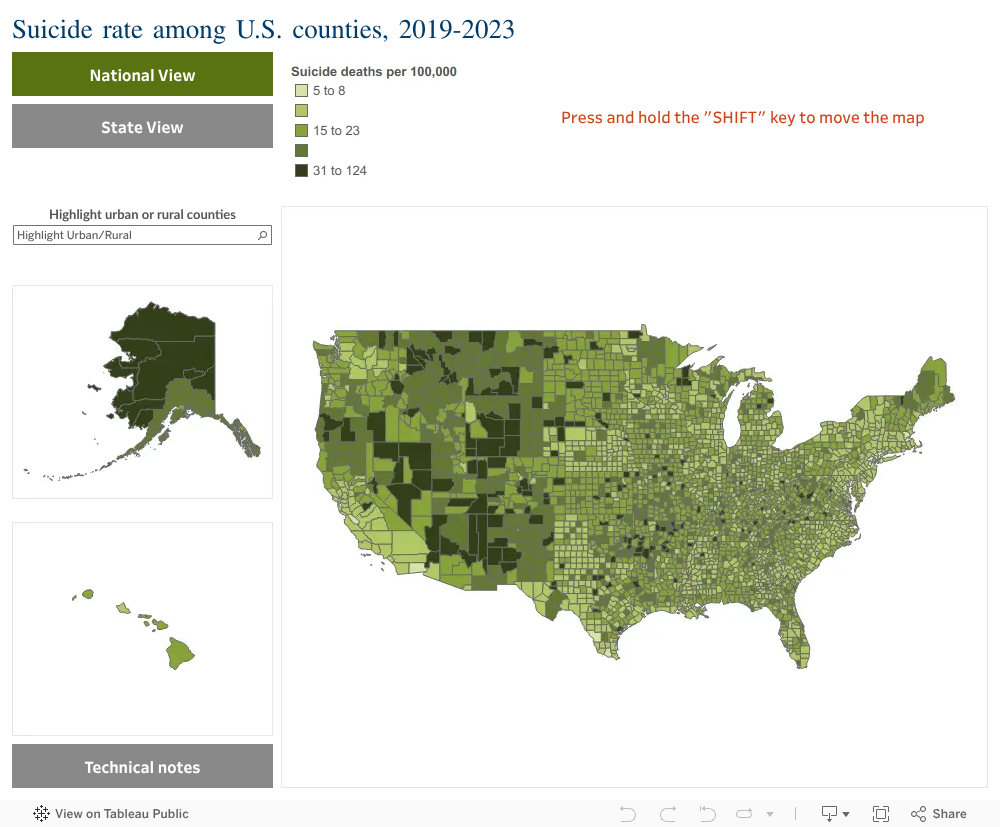
However, one may argue that drawing comparisons between large urban areas and small towns is impractical. What occurs when Clark County is evaluated against other counties with populations exceeding 1 million?
Even in this case, Utah’s Salt Lake County (19-20.9 per 100,000) and Arizona’s Maricopa County (17.5-17.7 per 100,000) often surpass Clark County’s suicide statistics, as noted during the years 2023-2025.
Indeed, Salt Lake City, a region characterized by strict vice regulations and religious influences, has a higher suicide rate than Las Vegas.
The Phenomenon of Suicide Tourism
The unique narrative surrounding Las Vegas is further skewed by the influx of approximately 40 million tourists each year. Among these visitors, roughly 30-40 succumb to suicide in hotel rooms on the Strip annually, based on data from the Clark County Coroner.
A significant 2008 study in Social Science & Medicine by researchers from Harvard, Temple, and UC Riverside revealed that a visitor’s risk of suicide doubles upon arriving in Las Vegas. Surprisingly, this is not a result of impulsive decisions following a financial loss at the tables. Researchers identified a specific “destination effect” — individuals already facing significant crises opt for Las Vegas as their ultimate exit point.
Moreover, the National Vital Statistics System mandates that all deaths are attributed to the decedent’s legal residence for public health assessments, rather than the location of death. Even if these 30-40 tragic incidents were included in the annual statistics for Clark County, the suicide rate would only rise by 1.5 points, reaching 17.5-18.5 per 100,000 — still below that of Salt Lake and most rural counties in the U.S.
Nonetheless, excluding these deaths from Clark County’s resident suicide statistics has fueled speculation of a concealment. Many question whether Las Vegas’ true suicide rate is significantly underreported to safeguard its tourism reputation, as victims of suicide at the Strip are typically removed discreetly.
Stay tuned for a forthcoming “Vegas Myths Busted” column where we’ll explore this further.
Catch “Vegas Myths Busted” every Monday on Casino.org. For a comprehensive archive of debunked Vegas myths, visit VegasMythsBusted.com. Do you have a Vegas myth that needs clarification? Reach out at [email protected].