


The National Council on Problem Gambling (NCPG) is standing firm on its decision to create a controversial prediction markets membership category, which was launched earlier this year alongside a $2 million donation.
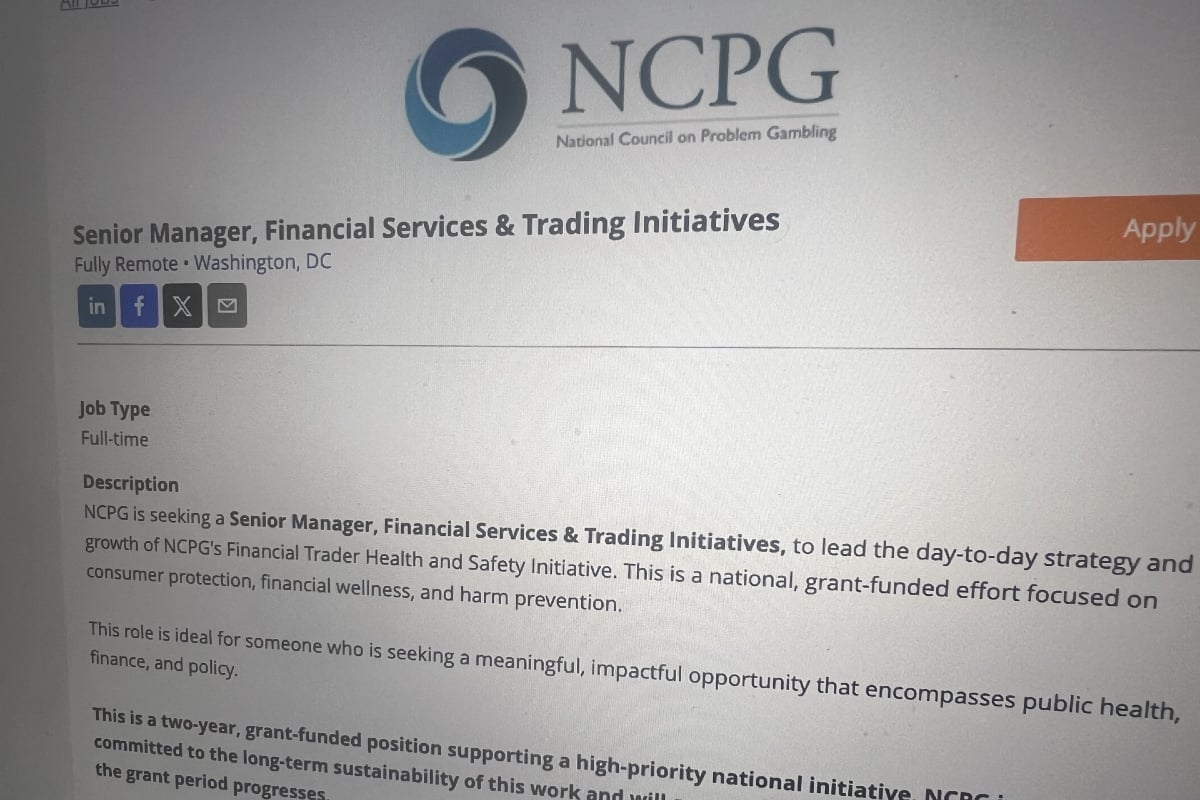
Despite assertions from the prediction market industry and the Commodity Futures Trading Commission (CFTC) that trading on these platforms is more akin to financial investing than gambling, the largest US-based prediction market joined the NCPG as a Platinum Member earlier this year. The NCPG introduced the Financial Services & Trading membership category and launched the Financial Trader Health and Safety Initiative with the $2 million grant.
Derek Longmeier, the board president of the NCPG, addressed the ongoing criticism on Tuesday (Sept. 22).
Regardless of how prediction markets are currently legally categorized, NCPG believes it functions similarly to gambling and can expose consumers to many risks related to traditional gambling,” Longmeier stated.
“The exposure today—in scale, in speed, and in reach to new and often young users—is unprecedented. NCPG is neutral on whether prediction markets should be legal. We are not neutral on the need to prevent and reduce gambling-related harm wherever it occurs,” Longmeier emphasized.
NCPG Stays Neutral
The NCPG is the sole national nonprofit committed to reducing gambling-related harm through advocacy and awareness initiatives. The organization operates the National Problem Gambling Helpline (1-800-MY-RESET / www.1800myreset.org) and finances research on problem gambling.
The NCPG has always maintained a stance of neither supporting nor opposing the legalization of gambling. It also affirms that its members and donors do not influence its research, advocacy, or public stances.
Longmeier clarified that the creation of the Financial Services & Trading membership subcategory was not influenced by a prediction market offering $2 million, but rather due to the proliferation of prediction markets since introducing sports-event contracts last year, posing a gambling-like threat to consumers.
Longmeier referenced a Harris Poll from June commissioned by the NCPG, which highlighted that 85% of Americans believe people can develop unhealthy or addictive behaviors on prediction market platforms. The poll also revealed that 84% of respondents think prediction markets should be treated as gambling with comparable consumer protections.
“For over 50 years, NCPG’s mission has been to assist individuals and families dealing with gambling-related harm. This mission has never been contingent on regulatory rulings or legal classifications, and it remains so,” Longmeier emphasized.
Individuals are facing genuine financial, emotional, and relationship consequences as a result of prediction markets. The harm is not theoretical, and action cannot be delayed,” Longmeier stated.
“NCPG’s existence is not to debate whether prediction markets or other emerging activities meet a legal definition of gambling, but to prevent and reduce gambling-related harm wherever it is present,” concluded the NCPG board chair.
NCPG Departures
Despite the NCPG’s efforts, the introduction of its prediction markets membership subcategory has led to three members—the Michigan Gaming Control Board, Ohio Casino Control Commission, and Nevada Council on Problem Gambling—severing ties with the organization.
Several other current NCPG members are currently considering whether to renew their memberships.