


Recent analysis from Bank of America confirms the challenges of breaking even in sports betting and highlights the difficulty of relying on it as a source of income.

Bank of America notes that the data only captures customer deposits and withdrawals from online sports betting platforms, leading to a cash recovery ratio below 1. This means customers typically recover less than 75 cents for every dollar transferred to online betting sites.
“Our analysis found the online betting cash recovery ratio has remained below 1, with total inflows less than three-quarters of total outflows on average for the duration of the series,” notes Taylor Bowey of the Bank of America Institute. “In other words, customers typically recover less than 75 cents for every dollar transferred to online betting platforms.”
During the period of January through July, the bank observed that bettors only recovered north of 75 cents for every $1 deposited on two occasions. This trend is concerning, especially considering that younger age groups dominated internet wagering activity. The bank’s analysis specifically focused on sports betting and prediction markets.
Can Sports Betting Provide Income?
While estimates vary, it is widely accepted that only 3% to 5% of sports bettors are profitable in the long term, indicating that relying on sports betting for income is challenging for the majority of individuals.
Despite these odds, younger bettors are increasingly incorporating sports betting and prediction market trading into their long-term financial plans. Even Gen Z, with the highest recovery ratio among the highlighted generations, is struggling to break even.
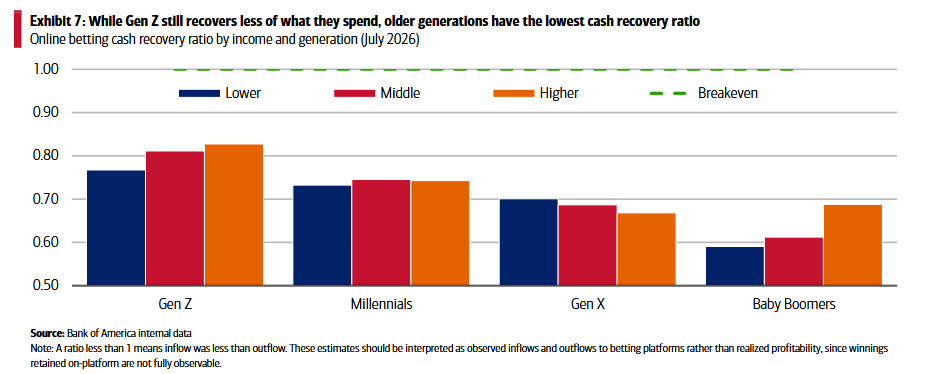
“Although Gen Z participants had the highest online betting cash recovery ratio across income groups, they still fell well short of breaking even,” says Bowey. “Despite seemingly recovering more than older generations, total inflows remained substantially below total outflows, suggesting that online betting is not a reliable or constant source of income.”
Aging and Betting Wisdom
As prediction markets and regulated sports betting gain popularity, more asset managers are concerned that the lines between betting and traditional investing are becoming blurred, particularly among younger bettors.
“According to a Bank of America proprietary survey, 20% of respondents view sports betting as a form of investment, with Gen Z being twice as likely to see it that way compared to other generations,” notes Bowey. “Across all age groups, buying event contracts on prediction markets is more likely to be considered an investment than sports betting.”
On the other hand, the majority of Baby Boomers and Gen X do not see sports betting as a form of investment. While their views on prediction markets are less clear, a significant portion of both demographics do not consider event contracts as investing either.