


Published on: November 20, 2025, 11:57 AM.
Updated on: November 20, 2025, 11:57 AM.

- Poverty rates dropped significantly following 1990s tribal casino growth
- A study shows tribal casinos boost jobs and wages for all racial groups
The enactment of the Indian Gaming Regulatory Act (IGRA) opened the doors for substantial casino development on tribal territories during the 1990s, generating significant economic changes.
Research by the Census Bureau alongside scholars from Johns Hopkins University and UCLA reveals that in 1989, 31% of individuals residing on tribal lands fell below the poverty line. Thanks to the economic growth driven by tribal casinos, that number decreased to 19.6% last year, albeit still higher than the national average of 12.1%.
The study indicates that tribal casino operations enhance wages for American Indians and decrease unemployment rates for local residents of all races engaged in casino-related sectors (Accommodation, Food Service, and Arts and Entertainment) compared to non-casino areas in the same state,” stated the Census Bureau.
The proliferation of tribal gaming in the United States has taken place at an impressive rate. There were no tribal casinos in 1989, but the current count is approaching 600.
Tribal Casinos: A Major Economic Force
Gaming establishments situated in Indian Country are notable for both their size and economic influence. Notably, nine out of the ten largest domestic gaming venues are tribal casinos.
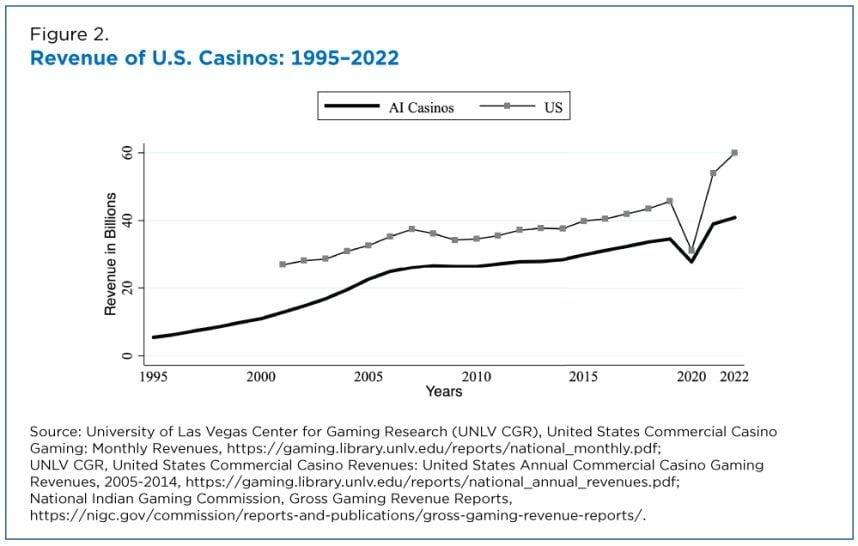
Tribal casinos have also proven to be exceptional revenue generators, achieving over $40 billion in annual sales in recent years. This revenue is crucial, as the IGRA mandates tribes to allocate a portion of their profits for economic growth and welfare programs within their respective reservations.
“It also suggests that direct cash transfer initiatives (such as per capita casino profit payments) may have played a role in the elevation of living standards for tribal citizens residing on reservations,” the Census Bureau states. “Thus, the IGRA, through enabling casino operations, can be interpreted as a targeted economic development policy focused on specific geographic regions.”
The revenue capabilities of tribes at their sovereign land gaming venues have also allowed them to expand into commercial gaming. At present, tribal entities operate numerous commercial casinos throughout the US, including in Las Vegas. For instance, in May 2021, Red Rock Resorts sold the Palms to California’s San Manuel Band of Mission Indians, and the Strip property formerly known as the Mirage will be managed by Hard Rock International upon its reopening.
Casino Ownership Benefiting Certain Tribes
The analysis by the Census Bureau also confirms that casinos have led to a notable increase in real per capita income on reservation lands, diversifying the economic foundations of tribes and facilitating unconditional cash transfers—akin to a universal basic income.
“Members of casino-owning tribal nations experienced a significant financial influx once their government implemented cash-transfer policies. Provided that the tribal nation has established unconditional cash transfers, all tribal citizens are eligible to receive these distributions, regardless of their residence location,” the Bureau mentions.
The findings also highlight that tribal casinos have resulted in an 11% reduction in childhood poverty on reservations and increased workforce participation among Native American women, alongside a 4% decline in overall unemployment rates.