


Published on: February 17, 2026, at 07:34h.
Updated on: February 17, 2026, at 07:35h.

- CFTC is engaging in federal proceedings about prediction markets
- CFTC Chair Michael Selig endorses the trading of sports event contracts in prediction markets
In response to a request from Senate Democrats urging the United States Commodity Futures Trading Commission (CFTC) to refrain from engaging in litigation concerning prediction markets, the chair of the agency announced that the CFTC would be submitting a friend-of-the-court brief today, lending support to Crypto.com in the Ninth US Circuit Court of Appeals.
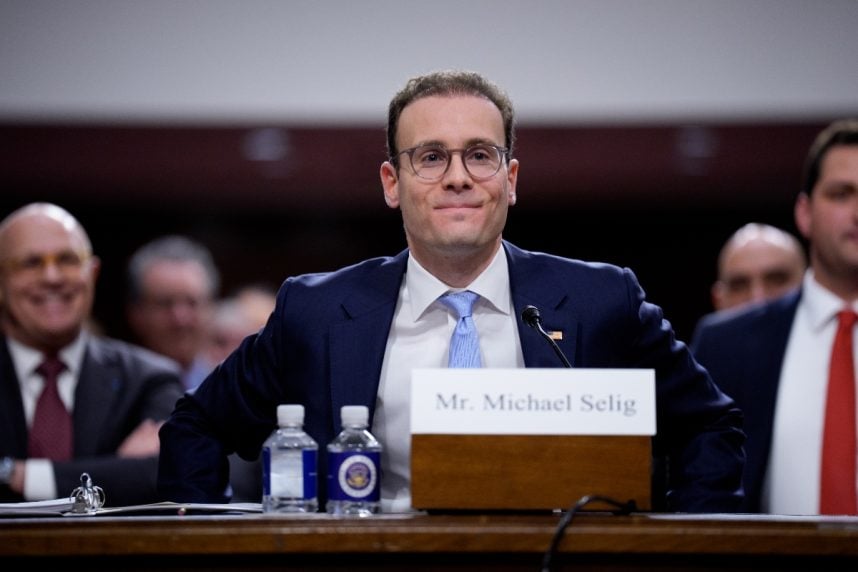
Michael Selig, the CFTC Chair, aims to revise regulatory guidelines governing prediction markets to confirm that trading platforms can engage in the buying and selling of sports events. He also seeks to establish that these markets can facilitate trading on political results.
State attorneys general, legislators, and gaming regulators assert that prediction markets that offer sports contracts are participating in illegal sports betting. They reference CFTC Regulation 40.11, a longstanding rule of over 15 years, which prohibits prediction markets from providing event contracts that involve any gambling.
Selig emphasizes the need to update regulations to promote “lawful innovation.”
Selig’s Op-Ed
In an op-ed published in the Wall Street Journal, Selig, who was appointed by President Donald Trump and took charge of the agency in December, articulated concerns that states have targeted the agency’s ability to oversee prediction markets as financial entities.
“Prominent CFTC-registered exchanges utilized by millions of Americans, including Kalshi, Polymarket, Coinbase, and Crypto.com, are facing a flood of state-driven litigation nationwide, with nearly 50 ongoing cases presenting various legal hurdles,” Selig remarked.
The predominant claim is that these contracts are a form of gambling and thus fall under state regulations. The CFTC will no longer remain passive while aggressive state governments undermine the agency’s exclusive authority over these markets by attempting to enforce statewide bans on these innovative products,” Selig added.
The CFTC head maintains that Congress has granted the agency extensive jurisdiction through the Commodity Exchange Act to define what constitutes a commodity and that the legislation is intended to accommodate financial advancements.
“Event contracts provide legitimate economic benefits. They enable businesses and individuals to hedge against risks associated with specific events, permit investors to manage exposure in their portfolios, and furnish the public with insights into future outcomes. For example, farmers can mitigate risks related to fluctuations in temperature affecting their crops, while small business owners can protect against tax hikes or spikes in energy prices,” Selig noted.
Concerns from the Casino Industry
A critical inquiry from opponents questioning the classification of the outcome of an NFL game as a commodity is, “Where does this all lead?”
If the CFTC can validate trading on the number of points a college basketball team is expected to score as a legitimate futures event contract, could the federal agency also conclude that trading on whether the next spin of a roulette wheel lands on black or red is acceptable? Furthermore, what about trading on the results of winning or losing from a slot machine, an automatic blackjack hand outperforming the dealer, or a simulated baccarat outcome?