


Published on: October 30, 2025, 04:38h.
Updated on: October 30, 2025, 04:53h.

Following President Trump’s announcement on Truth Social that he ordered the Pentagon to recommence nuclear testing “immediately,” Las Vegas officials responded strongly.
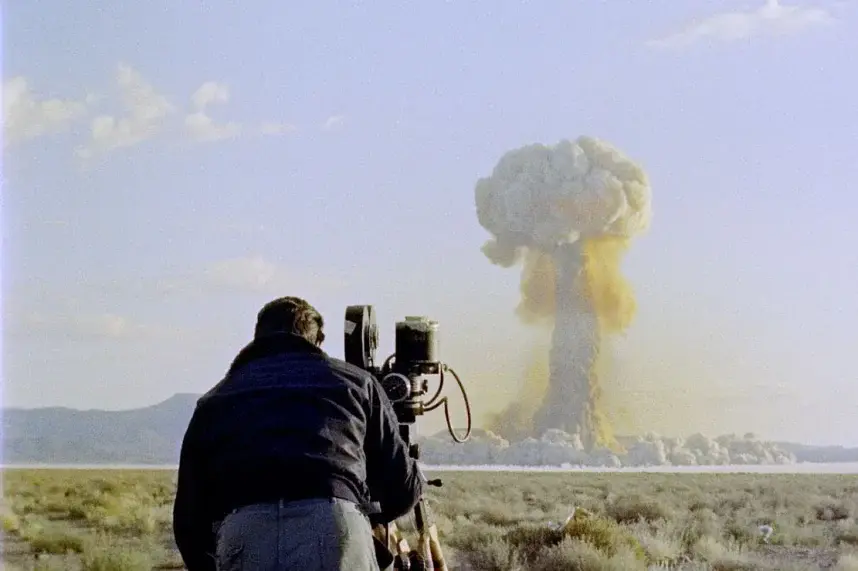
Officials recognized that the Nevada National Security Site (NNSS), located 65 miles northwest of the Strip, is the sole remaining U.S. site equipped for full-scale nuclear tests. Building a new facility, if that is indeed the president’s expedited aim, would simply take too long.
“No way,” tweeted Nevada Democratic U.S. Representative Dina Titus, D-Nevada, on Wednesday. “I’ll be introducing legislation to prohibit this.”
Trump justified his decision by claiming that other nations are currently testing nuclear arms.
“We paused these tests for many years, but seeing others conducting their tests, it’s only right we follow suit,” he stated to reporters aboard Air Force One.
This stance aligns with Project 2025, a document that has guided several policies during the Trump administration. It advocates for the U.S. to “reinstate the nuclear infrastructure” and to “be ready to test nuclear arms at the Nevada National Security Site.”
“This sharply contradicts the assurances I received from Trump appointees—and from administration experts confirming our nuclear arsenal—who assured me that explosive nuclear testing would remain unnecessary and wouldn’t take place,” Nevada U.S. Senator Jacky Rosen, D-Nevada, tweeted on Wednesday.
“I will actively work against this,” she pledged.
Underground Zero
The first of 100 detonations took place in January 1951 over the Nevada Proving Ground, covering an area of 1,355 square miles, which had been carved out from the Nellis Air Force Gunnery and Bombing Range. This area was renamed the Nevada Test Site in 1955 and later rebranded as the NNSS in 2010.
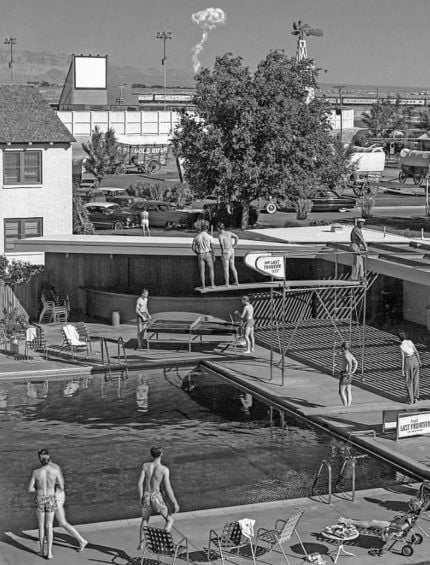
These aboveground tests, often watched by tourists from Las Vegas venues during “atomic viewing parties,” ceased with the signing of the Partial Test Ban Treaty in 1963.
While most believe nuclear testing ended there, it actually continued until September 1992, well after the Mirage Hotel had opened three years earlier.
The fact that an additional 828 nuclear tests were conducted at the Nevada Test Site remained largely unknown, as none produced a visible mushroom cloud in Las Vegas—only occasional vibrations were felt.
These detonations left extensive irradiated areas at the Nevada site, with fallout linked to increased rates of cancer and other severe health issues among local workers and residents.
Notably, they have also been associated with the deaths of actor John Wayne and other cast members of the 1954 film “The Conqueror,” which was filmed 137 miles downwind from the Nevada Proving Ground. Of the 200 individuals involved in the production, 91 developed cancer.
A persistent advocacy by self-identified “downwinders” led Utah Senator Orrin Hatch (R) to champion the 1990 Radiation Exposure Compensation Act. This $100 million package provided $50,000 each to families in Nevada, Utah, and Arizona who could connect cancers and other illnesses to fallout exposure.
A congressional ban on all nuclear testing, driven by health, environmental, and geopolitical considerations, was enacted by President George H.W. Bush. The last test, codenamed Divider, was carried out on September 23, 1992.
Since that time, the National Nuclear Security Administration has only conducted subcritical (non-explosive) nuclear experiments on the site.