


Date of Publication: March 27, 2026, 02:05h.
Last Modified: March 27, 2026, 02:15h.

- In 1929, Las Vegas erected a wooden arch to impress federal dam officials visiting the area.
- The city was ultimately rejected due to its local vices, leading to the creation of Boulder City instead.
- It wasn’t until 1959 that an official neon welcome sign was constructed.
The iconic “Welcome to Las Vegas” sign wasn’t the first of its kind; that honor belongs to a wooden arch built in 1929 over Fremont and Main Streets. What’s truly captivating about this initial sign—and often overlooked in many accounts of its history—is that it was created for a specific purpose, one it ultimately failed to achieve.
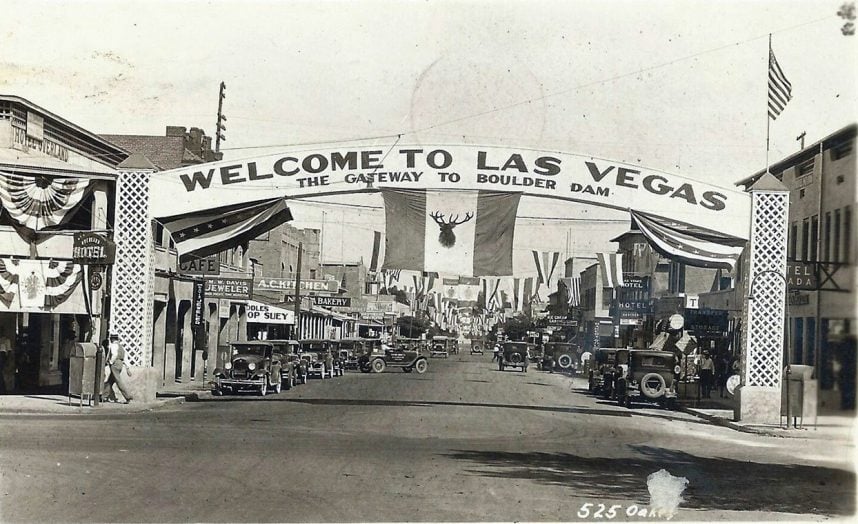
Rather than welcoming tourists—who were scarce at the time—the arch was intended to greet two pivotal figures: U.S. Secretary of the Interior Ray Lyman Wilbur and Elwood Mead, the Commissioner of the Bureau of Reclamation, after whom the lake was named.
According to the Las Vegas Evening Review, “Painters toiled from 11 o’clock last night until 6 this morning to complete the grand welcome arch, specifically designed to honor our esteemed guests.”
Wilbur and Mead were in Las Vegas to determine if it would serve as the primary construction hub for Hoover Dam—or if a different location needed to be established to accommodate the influx of 5,000 workers. Construction was set to kick off in September 1930.
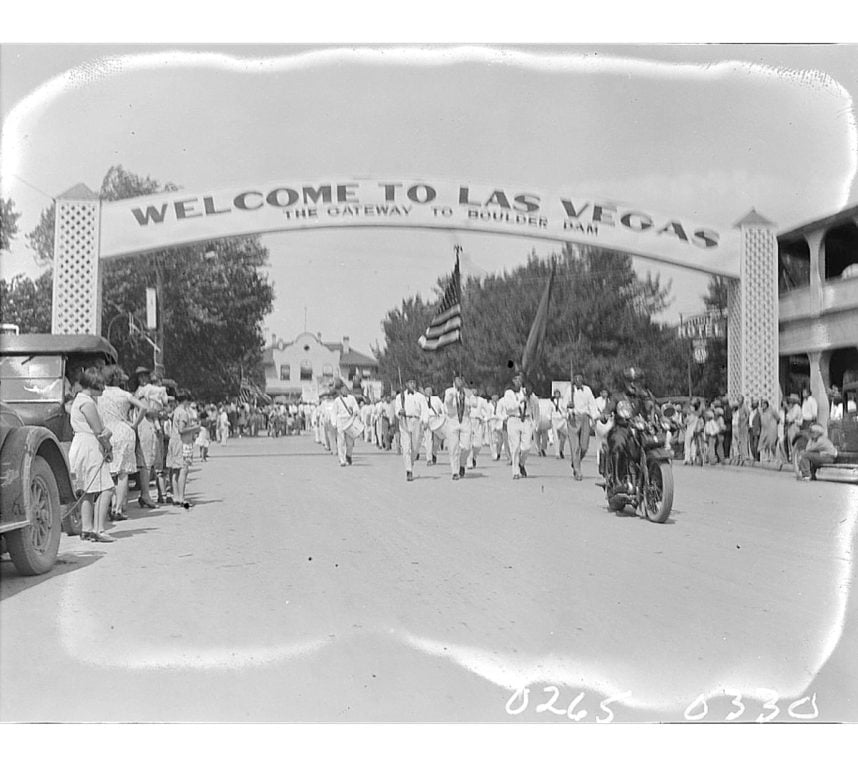
The arch was strategically positioned facing the Los Angeles & Salt Lake Railroad station, ensuring that its ambitious message—“Welcome to Las Vegas, The Gateway to Boulder Dam”—was the first thing the officials would notice upon their arrival.
Clean Slate Efforts
Local authorities prepared for their visit by temporarily closing down Block 16, the notorious red-light district known for tolerating gambling and drinking, while allowing legal prostitution. The intent was to present Las Vegas as a family-friendly destination.
Despite the cleanup efforts, the grand sign, and the warm welcome organized at the Elks Lodge, the strategy ultimately backfired. During an unsupervised tour, Wilbur’s executive assistant, Northcutt Ely, encountered a laborer who was clearly intoxicated.
Consequently, Wilbur and Mead opted for a different solution, deciding against exposing the dam workers to Las Vegas’s excesses of alcohol, gambling, and women. Instead, they constructed Boulder City near the dam site as a model town where such vices were strictly prohibited. (To this day, gambling remains illegal in Boulder City, and hard liquor sales were banned until 1969.)
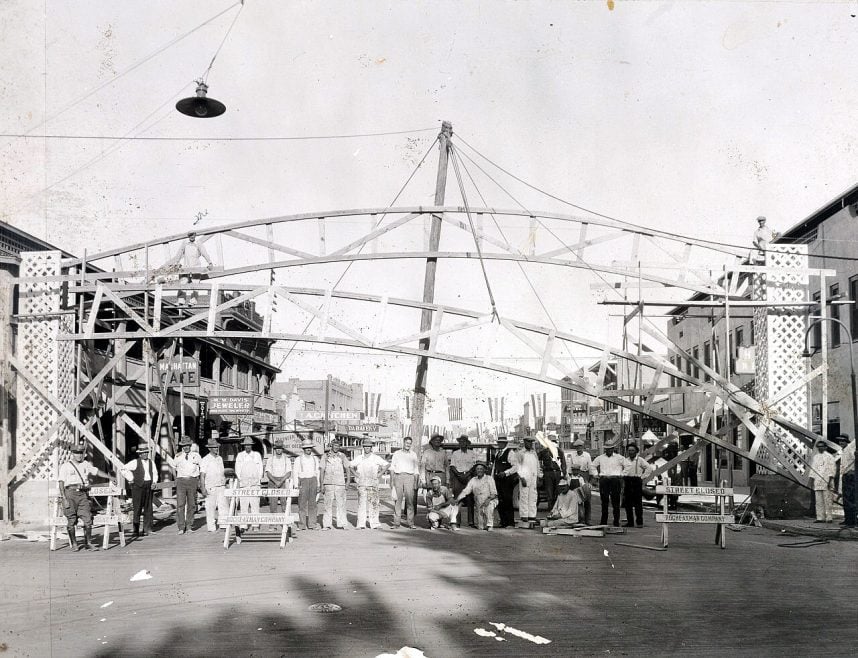
The arch was taken down on April 3, 1931, serving as a reminder of its unsuccessful purpose. Additionally, it became outdated as, just seven months earlier, Wilbur had renamed the dam in honor of President Herbert Hoover. (Since its completion in 1936, it has never been officially referred to as Boulder Dam.)
Following this, aside from basic highway signs indicating city limits, no further welcome signs for Las Vegas were erected until the iconic neon sign appeared at the southern end of the Strip in May 1959. Downtown received its own welcome sign much later, in 2002.
A Snapshot of Milestones
The primary image accompanying this article not only depicts the first welcome sign of Las Vegas but also showcases the first instance of a neon sign in the city. These were separate milestones, as the original welcome sign did not feature any neon lighting.
The small tombstone-shaped sign on the left side, which announced the name of the Overland Hotel on Fremont Street, represented Las Vegas’ inaugural use of neon gas that would eventually become a hallmark of the city.
According to the Las Vegas Evening Review, “The Overland Hotel is now showcasing a new neon gas-electric sign with a cutting-edge design, significantly enhancing the look of that area.” This was reported in the September 28, 1928 edition.
Interestingly, no one preserved Las Vegas’s first neon sign either. When the Overland replaced its initial neon sign with a larger one three years later—which it would do again seven years thereafter in an escalating competition for flashy signage—nobody anticipated a neglected, bird-poop-covered sign would ever be regarded as a historical artifact.
“Lost Vegas” is a periodic Casino.org series that delves into the overlooked aspects of Las Vegas history. Click here for additional entries in the series. Have a compelling Vegas story lost to time? Reach out to [email protected].