


Published on: December 14, 2025, 10:49h.
Updated on: December 14, 2025, 10:49h.

- NCAA President Charlie Baker admits he underestimated the prevalence of sports betting
- Baker enacted Massachusetts’ sports betting legislation in April 2022
While serving as the governor of Massachusetts, NCAA President Charlie Baker spearheaded the legalization of sports betting in 2022. Now, in his role within college athletics, he acknowledges that he misjudged just how deeply sports betting would integrate into American culture and the collegiate atmosphere.
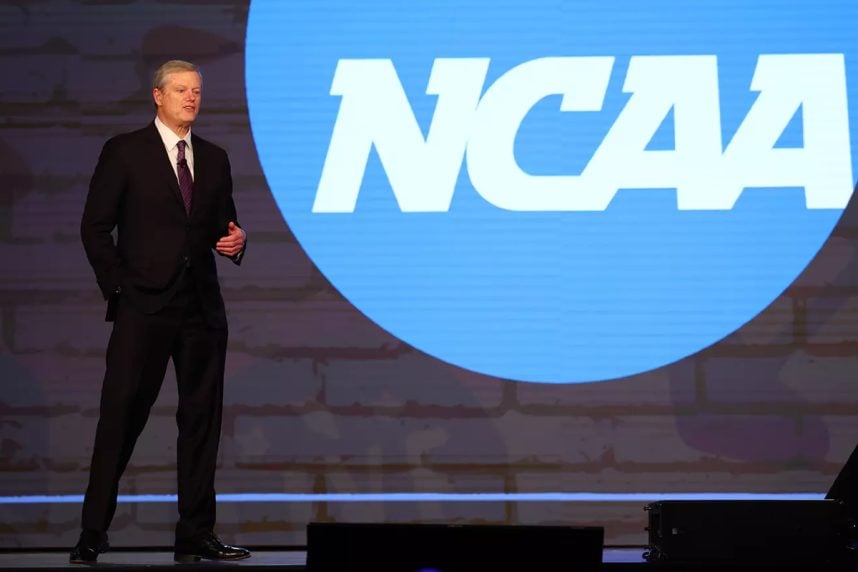
Having served two terms as Massachusetts governor, Baker took on the role of NCAA president in March 2023. One of his initial priorities was to examine the effects of expanded sports gambling on college athletes and students.
“Following my appointment, I met with around 1,000 student athletes on various campuses. A significant portion of those discussions revolved around sports betting, particularly the issues of abuse and harassment tied to it,” Baker shared in a Yahoo! Sports interview.
Baker reported that sports betting culture, encompassing both professional and collegiate events, has become prevalent. He reached the conclusion that legalization has led to widespread acceptance.
“I firmly believe that when something is illegal, it makes people rethink their choices,” Baker expressed. “Consequently, one cannot overlook the influence of advertisements in normalizing sports betting.”
Reflections on Decisions
Baker enacted the sports betting law in Massachusetts in April 2022, at the time expressing satisfaction to ratify such legislation.
The law imposes a 15% tax on retail activities and a 20% tax on online transactions. Massachusetts has received over $300 million in tax revenues from sports betting, but Baker questions whether these benefits are truly worth the costs.
With the pervasive advertising efforts from companies like DraftKings and FanDuel, plus in-game odds prominently highlighted by ESPN and similar outlets, Baker states that sports betting “has permeated every aspect of media.”
“No one anticipated its omnipresence, especially with DraftKings and FanDuel creating mobile opportunities for betting on nearly any occurrence,” Baker commented.
Baker has consistently opposed prop bets based solely on individual athlete performances. He argues that such wagers increase the risk of harassment toward players, be it through fan interactions during games or hostile online commentary.
“Most of the aggressive harassment directed toward athletes originates from this area. Furthermore, pressures from underperforming prop bets affect these young individuals significantly, a phenomenon not yet fully grasped,” Baker explained.
The Evolving Sports Betting Environment
Since the US Supreme Court granted states the authority to decide on sports betting legality, 39 states and Washington, D.C. have legalized some form of sports gambling. However, the growth rate has slowed recently as remaining states tread carefully in their legislative approaches.
States that have yet to authorize sports betting include prominent areas such as California, Georgia, South Carolina, and Texas.