


Published on: December 11, 2025, 08:02h.
Last updated on: December 11, 2025, 08:02h.

- Is President Donald Trump contemplating the removal of gambling taxes?
- The president made a light-hearted remark, yet substantial changes appear unlikely.
- The gaming sector aims to restore the gambling loss deduction to its full 100%.
Yesterday, the media erupted with excitement after President Donald Trump hinted at the possibility of abolishing the federal tax on gambling winnings.
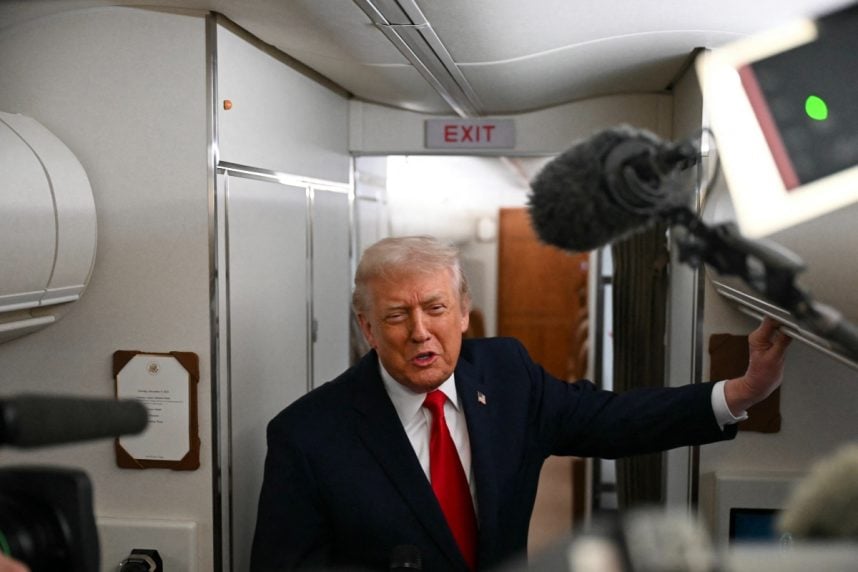
Traveling on Air Force One, Trump responded to a question from the press regarding the potential elimination of gambling tax.
“Mr. President, remember when you promoted ‘No Tax on Tips’ in Las Vegas? Have you ever thought about applying that to gambling winnings?” a journalist inquired anonymously.
“No tax on gambling? I’m not certain about that. We have ‘No Tax on Tips’, no tax on Social Security, and no tax on overtime. The idea of eliminating taxes on gambling winnings? I’m still mulling it,” Trump replied with a chuckle.
Despite numerous news outlets speculating about Trump’s serious consideration of abolishing gambling taxes, his tone suggested a more casual approach. To view Trump’s full comments regarding gambling taxes, click here.
Bipartisan Support for Gambling Tax Legislation
The gaming industry is not advocating for the abolition of federal taxes on gambling winnings; rather, it seeks to reinstate the ability to deduct losses against winnings. Trump’s One Big Beautiful Bill Act proposes to cut the gambling loss deduction to 90% starting next year.
Interestingly, Trump did not address this specific tax provision during his remarks at Mount Airy Casino Resort.
US Representative Dina Titus (D-NV) is pushing to reinstate the gambling deduction with the FAIR Bet Act in the House. Meanwhile, Senator Catherine Cortez Masto (D-NV) has introduced the FULL House Act in the Senate to revert the gambling deduction back to its full 100%.
Both initiatives receive robust bipartisan backing, with Titus’s FAIR Bet enjoying 21 cosponsors, including eight Republicans. The FULL House Act has five cosponsors, of which four are Republican, including Senator Ted Cruz (R-TX).
Cortez Masto has criticized the Senate Republican leadership for hindering the FULL House Act unless additional provisions are included.
“It’s unfortunate that we cannot move forward with this straightforward FULL House Act because Republicans wish to clutter it with unrelated issues. This legislation should alleviate the tax burden on losses, which is entirely counterproductive,” Cortez Masto said in July.
“The irony of @POTUS discussing affordability at a casino is rich, considering tourism is struggling due to his strategies, while the gaming sector is left without a solution to the 90% gambling loss deduction due to his hefty Budget Bill,” Titus expressed on X this week.
The American Gaming Association, representing the interests of commercial and tribal gaming industries across the nation, has consistently urged Congress to restore the gambling deduction.
“This sets a dangerous precedent by taxing non-existent income while disproportionately affecting a legal and heavily regulated sector,” stated AGA President and CEO Bill Miller. “We advocate for prompt measures to ensure fairness and consistency in taxation for American consumers.”
Minimal Federal Revenue Impact
Reducing the gambling deduction to 90% would have severe implications for professional gamblers, while the federal tax benefits would be minimally significant.
Estimates from the Joint Committee on Taxation indicate that the rollback of gambling loss deductions would yield only $1.1 billion in extra federal income over an eight to ten-year timeframe. To put this into perspective, the federal government incurs expenses close to $800 million every hour.