


Published on: May 29, 2026, 08:25h.
Updated on: May 29, 2026, 08:25h.

- Current discussions on the extent of igaming promotions in Canada are affecting the viability of a Quebec market similar to Ontario’s.
- Research indicates a staggering $2.3 billion in GGR is forfeited to the unregulated market in Quebec.
- A representative from the Coalition of private operators noted that the opposition parties in Quebec are increasingly considering an igaming framework akin to Ontario’s.
The current advertising landscape for igaming in Canada is hindering the establishment of a competitive Ontario-like market in Quebec, according to a spokesperson from a coalition of private operators eager to enter that market.
National Advertising Legislation
The conversation regarding excessive gambling advertisements, particularly during televised sports broadcasts, was a prominent subject at SBC Summit Canada in Toronto last week.
Opponents argue that gambling promotions are omnipresent and may contribute to gambling addiction and public health issues. However, industry entities including operators and broadcasters have advocated strongly against a blanket ban.
Federal Bill S-211, titled the National Framework on Sports Betting Advertising Act, is currently progressing through Parliament, aiming to establish nationwide regulations for gambling advertisements.
Concerns Over iGaming Advertisement Volume
Ariane Gauthier, the spokesperson for the Quebec Online Gaming Coalition, is closely monitoring this legislative process, as her organization continues to urge both the provincial government and opposition members to consider implementing an Ontario-like framework.
The Coalition comprises companies like Apricot, Bet99, Betway, DraftKings, Entain, Flutter, and Rush Street.
“The primary issue conveyed by nearly everyone I interact with is related to advertising and promotional activities,” she stated.
That has emerged as the substantial reason hindering market liberalization, according to her discussions.
Upcoming Quebec Election in October
“The advertising landscape in Ontario reflects their decisions,” she noted. “We can set up regulations for private igaming services in Quebec with different, perhaps more stringent parameters. A simple model replication isn’t necessary.”
Another factor maintaining the current state is the intention to safeguard Quebec’s cultural integrity, particularly through Loto-Québec’s government monopoly, which may be threatened by large U.S. operators such as DraftKings and FanDuel if the market opens.
Hence, Gauthier emphasized that Loto-Québec will still play a crucial role in any future regulatory framework that encourages competition.
Competitive Markets in Alberta and Ontario
The Summit featured significant discussions about whether Quebec could follow the lead of Ontario and Alberta, the latter of which will see its competitive market launch on July 13.
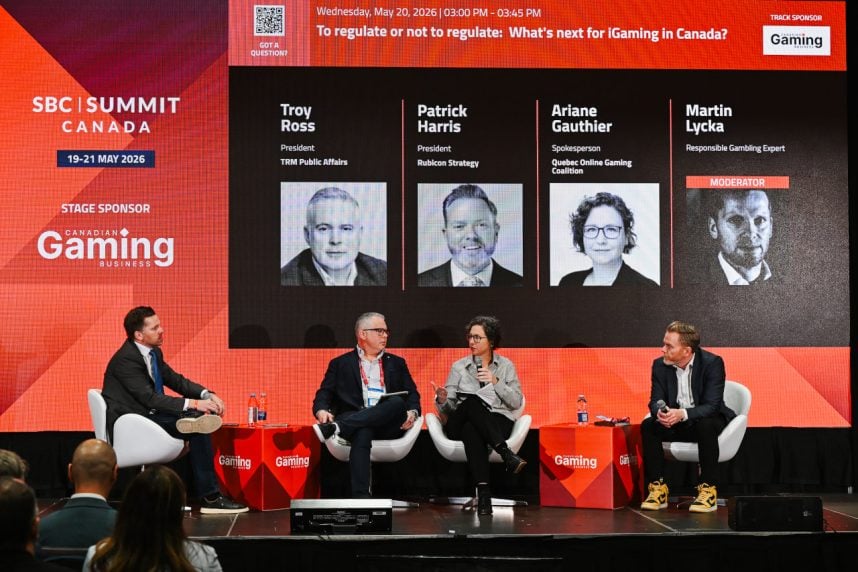
Gauthier participated in a panel alongside Patrick Harris from Rubicon Strategy and Troy Ross from TRM Public Affairs, exploring which provinces might adopt a competitive market structure to challenge government monopolies.
“Transitioning from one to two provinces represents a notable advancement,” Ross remarked. “Especially considering the combined populations of Alberta and Ontario approach 21 million, nearly half of Canada’s total. Reaching this threshold signifies a pivotal moment for nationwide regulation.”
Upholding the Social License
Harris noted that in Ontario and Alberta, the transition to an open igaming market stemmed from political momentum spearheaded by new leadership willing to make changes.
“I believe every province is evaluating this situation,” he said. “Two key motivators for politicians are public sentiment and potential revenue. There are greater financial benefits associated with regulation. The general populace has shown support for it. The critical issue moving forward is how industries manage their operations in Ontario and Alberta, as this social license will dictate whether similar frameworks can be extended throughout Canada.”
In a subsequent interview with Casino.org, Gauthier mentioned that the ruling party in Quebec, the Coalition Avenir Quebec, is opposed to the idea of opening the market to competitors challenging the Loto-Québec monopoly.
Loto-Québec Monopoly
Nevertheless, with a provincial election looming in October, current polling data from 338Canada.com reveals a tight three-way race: the Parti Québécois is leading at 30%, trailed by the Liberals at 28%, and the CAQ at 20%.
Gauthier reported that the Quebec Online Gaming Coalition has engaged with both the PQ and Liberal party, facing “challenging inquiries,” but found both parties to be potentially open to altering the province’s stance and introducing regulations for a competitive online gaming environment.
“They exhibit a comprehension of the global landscape of this market,” she stated. “Quebec is keenly interested in exploring different models, observing the frameworks in Ontario, Alberta, and also considering European examples.”
$2.3 Billion in GGR Lost to Unregulated iGaming
Gauthier refrained from providing a specific timeline for when the market might open but mentioned, “There is certainly reflection occurring behind the scenes.
“Substantial developments are taking place quietly, and progress is being made,” she added.
Research from TRM Public Affairs indicates that only 27% of the total market share in Quebec is being directed towards Loto-Québec, leaving 73% to the unregulated sector, which equates to a loss of CAD $2.3 billion in GGR for the regulated market and an approximate CAD $563.3 million in revenue that the government could be missing out on (based on an 80% operators/20% government split).
Growth Potential in Quebec’s Market
Gauthier referenced comments made by Jean-Francois Bergeron, CEO of Loto-Québec, to the cabinet just prior to the summit, indicating that the igaming sector in Quebec had experienced 20% growth last year.
Nevertheless, Gauthier contends that this growth signifies the provincial government is forfeiting even more revenue year after year, leading to a loss of control over the online gaming sector.
“Perhaps Loto-Québec is providing a safe gaming environment for players, but it does so only for a fraction of its audience,” stated Gauthier. “What occurs to the other segment?”