


Published on: December 17, 2025, 07:01h.
Updated on: December 17, 2025, 07:03h.

- Study ties legalized sports betting to increased violent crime on game days.
- Assault incidents surge after games start, particularly during home matches and unexpected victories.
- Nearby states also experience a rise in crime; factors include stress levels, overtime games, and tight scores.
Recent findings indicate that sanctioned sports betting across the United States correlates with a notable rise in impulsive and violent crime during game days.
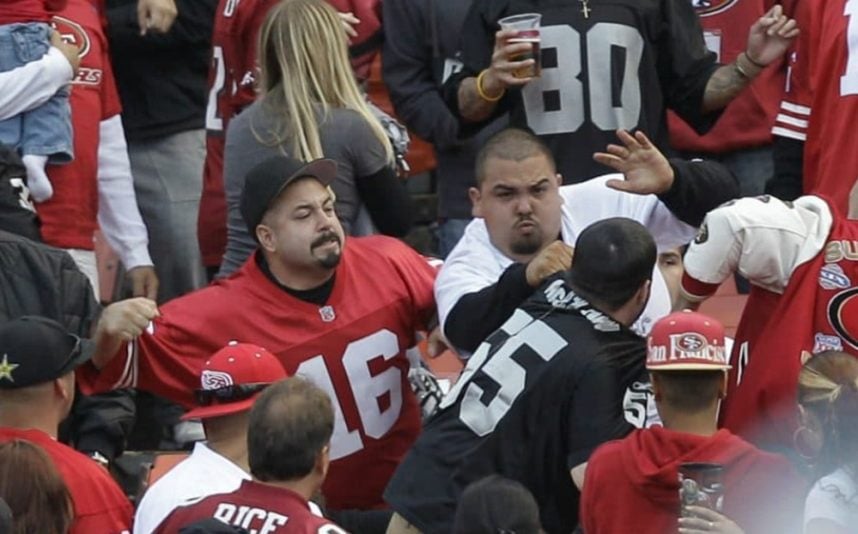
The collaborative research conducted by the University of Michigan and Rice University, published in the Journal of Sports Economics, scrutinized crime statistics from the National Incident-Based Reporting System (NIBRS) spanning 2017 to 2021.
The research asserts that crime rates escalate by 30% to 70% from kickoff to several hours post-game in states where betting is legalized, with assaults experiencing the highest increase of up to 93%.
Notably, these effects are most pronounced during home games, particularly following unexpected losses, indicating that emotional reactions to “underdog victories” are significant triggers.
Emotional Reactions Versus Financial Pressure
The study also highlights spillover effects into adjacent states lacking legalized betting, attributed to cross-border betting behavior.
“It is important to recognize that aggression may not exclusively arise from financial pressure, as commonly observed in various betting situations,” remarked Wenche Wang, assistant professor of kinesiology at the University of Michigan and lead researcher.
Our findings provide evidence of a heightened crime incidence linked to stressful game scenarios, such as those featuring close or tied scores, as well as matches that extend into overtime.
Wang further emphasized that data suggests that regions with legalized betting may be especially prone to escalated aggressive behaviors, indicating that heightened crime rates could occur even in games without financial losses.
Critically, the study does not establish that sports betting incites violence solely through financial losses. Instead, it posits that legalized betting can amplify the emotional stress connected to games, which exacerbates reactions to both victories and defeats.
This aligns with previous research from the University of Oregon, which found that unexpected losses by local teams correlate with spikes in domestic violence, with a stronger effect in states permitting legal sports betting.
Additional Contributing Factors
Sports events inherently involve alcohol consumption, large crowds, and elevated emotional states—all factors independently associated with spikes in violent or disorderly conduct.
Separating the specific impact of legalized betting from these established game-day factors presents methodological challenges.
Nonetheless, Wang asserts that her research highlights serious societal implications stemming from sports betting that must be addressed.
“Policymakers should implement safeguards, enhance consumer protections, and increase public awareness as the industry continues to evolve,” she proposed.