


Published on: May 28, 2026, 06:38h.
Updated on: May 28, 2026, 07:27h.

- Spain has imposed a temporary ban on Kalshi and Polymarket
- Officials argue that these prediction markets are participating in illicit gambling
- Spain joins over a dozen nations in taking action against prediction markets
Spain has emerged as the latest prominent economy to restrict online prediction markets, instituting immediate website blocks in response to escalating global regulatory scrutiny of the industry.
On Tuesday, May 26, former US President Donald Trump voiced his strongest endorsement yet for the contentious trading platforms that permit users to buy and sell shares in future events. Meanwhile, more than a dozen nations have moved to restrict their operations.
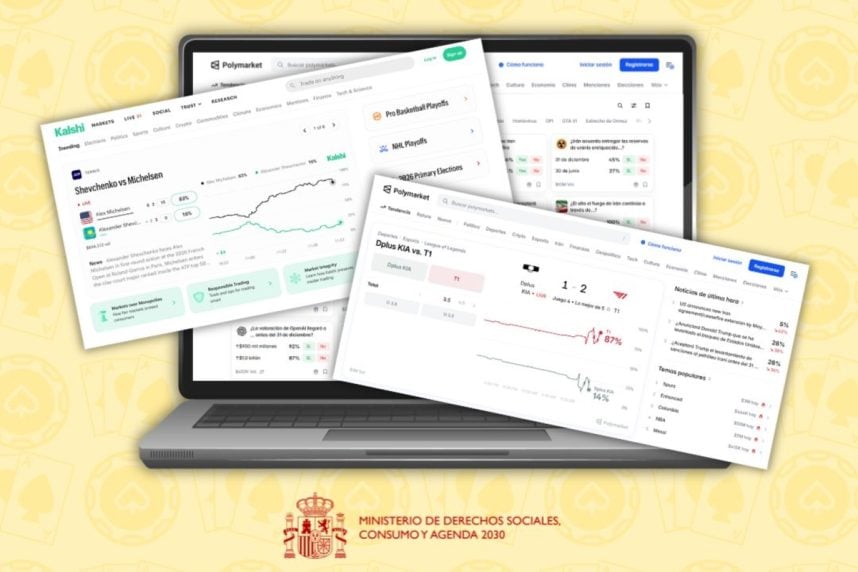
On Monday, May 25, Spain’s Consumer Rights Ministry announced a temporary suspension of leading prediction markets Kalshi and Polymarket. This suspension follows an investigation into their business practices.
The ministry confirmed that both prediction markets are facing disciplinary actions, based on claims of non-compliance with gambling regulations.
“The Consumer Affairs Department has directed a block on both websites in Spain as a precautionary measure until the final decision regarding the proceedings,” noted the ministry’s official statement.
Furthermore, the statement elaborated that Spain regards prediction markets as a form of gambling when wagers are placed on uncertain results.
“As such, lawful operations in Spain necessitate a specific administrative license. Unauthorized operators do not possess the necessary technical and regulatory safeguards, including identity verification, age restrictions, and mechanisms to prevent access by self-excluded or prohibited individuals,” the release stated.
Worldwide Clampdown on Prediction Markets
Prediction markets have been around for some time, but the trading opportunities they provide are relatively new. In recent months, US-based prediction markets have introduced offerings related to events such as sports outcomes, elections, and even significant geopolitical happenings like regime changes and government leader ousting.
Critics of prediction markets argue that these platforms enable betting on nearly anything and pose risks of insider trading. Consequently, various nations have begun taking steps to restrict access to these sites.
Spain now joins Italy, France, Germany, Belgium, Hungary, New Zealand, and Brazil in enacting measures that render prediction markets inaccessible. Romania, Portugal, Australia, Argentina, and Indonesia have specifically targeted Polymarket.
Unlike traditional wagering systems where gamblers bet against a house, prediction markets are ostensibly peer-to-peer. However, Kalshi and Polymarket have partnered with third-party intermediaries, usually large financial entities, to take the opposing side of trades and user-generated combinations.
Trump’s Endorsement
As a Republican-led House Oversight Committee commenced an investigation into insider trading within prediction markets, the former president reiterated his support for these financial exchanges.
Trump emphasized that it is “critically important” for the Commodity Futures Trading Commission to maintain its “exclusive authority” over prediction markets.
The ongoing scrutiny of prediction markets, which includes allegations of insider trading and the debate over whether sports trading should be classified as sports betting, remains a topic of bipartisan concern. The US Supreme Court has been petitioned to determine if states hold any regulatory authority over the offerings of prediction markets.