


Published on: March 30, 2026, at 09:25h.
Revised on: March 30, 2026, at 09:25h.

- Tax and law academics oppose reinstating the gambling deduction.
- They argue that gambling does not qualify as a business or occupation.
A group of tax and law scholars from the University of Alabama and Rutgers has published an op-ed asserting that the IRS tax code should not be modified to revert the gambling deduction back to 100% of losses against winnings.
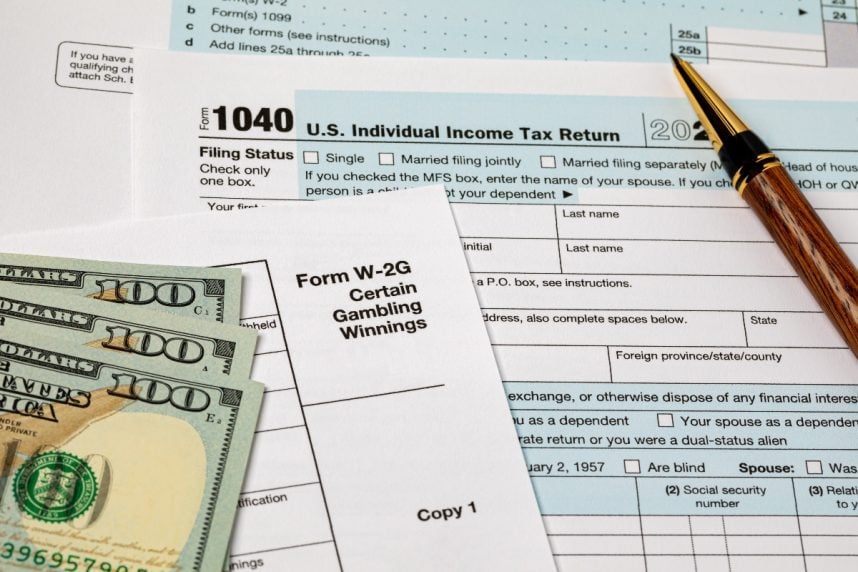
The One Big Beautiful Bill (OBBB), spearheaded by Republicans and President Donald Trump, lowered the allowable gambling loss deduction from 100% to 90%. As a result, an itemized filer who earns $100,000 through gambling yet incurs equal losses would still face federal taxes on $10,000.
Critics, including members of Nevada’s congressional delegation, argue that this tax alteration is unjust, causing gamblers to face taxes on imaginary earnings—income that was never truly realized by the year’s end. Detractors of the OBBB warn that this tax shift may drive both professional and casual gamblers to offshore gambling venues, possibly resulting in job losses and diminished tax revenue.
An opinion piece in The Hill suggests that the reduction of the gambling deduction from 100% to 90% is a justified change.
Op-Ed on Gambling Deductions
Mirit Eyal-Cohen, the Joseph D. Peeler Professor of Law at the University of Alabama School of Law, and Jay Soled, the distinguished professor of Taxation at Rutgers Business School, argue that the OBBB’s gambling deduction clauses improve the consistency of the tax code by removing a deduction related to personal spending. They claim that gambling should not be classified as a business pursuit.
“Since gambling is a form of entertainment, deductions for gambling losses should be eliminated entirely from the tax code. It is a kind of personal consumption rather than productive economic activity,” the op-ed stated.
Typically, the IRS prohibits the deduction of personal consumption expenses, while business and investment-related costs are generally deductible.
“Some might contend that taxation on gambling winnings necessitates an offset for losses, akin to stocks or investments. However, the tax code already disallows deductions for income-generating activities tainted with personal consumption, such as treating a prospective client to a Broadway show. Consistent application demands the denial of any gambling loss deductions,” the opinion piece further added.
Furthermore, Eyal-Cohen and Soled point out that gambling deductions disproportionately favor high-income individuals at the expense of lower-income taxpayers.
“Equity remains a crucial factor. The existing gambling loss deduction framework designed by Congress unfairly advantages wealthy taxpayers while disadvantaging a large number of low- and moderate-income taxpayers. How is this possible? While all taxpayers must declare their gambling winnings, higher earners—who typically itemize deductions—can write off most of their gambling losses, whereas lower earners often opt for the standard deduction and miss out,” the authors argued.
Republican Opposition to Gambling Tax Restoration
Rep. Dina Titus (D-NV) has gained bipartisan backing, with 11 Republican members co-sponsoring her FAIR Bet Act. Meanwhile, Sen. Catherine Cortez Masto (D-NV) introduced the FULL House Act, similar legislation aimed at reinstating the 100% gambling deduction, yet it has only secured support from four Republican co-sponsors.
Republican leaders in both chambers of Congress have obstructed the restoration of the gambling deduction. The FAIR Bet Act has been stalled in the House Ways and Means Committee since last July, while the FULL House Act has remained stagnant in the Senate Finance Committee since its referral last summer. Additionally, efforts to attach gambling deduction provisions to spending and appropriations bills have been actively removed by Republican leadership.
The changes made by the OBBB tax law will not impact returns for 2025, which are due next month. The new regulations will apply starting with the 2026 tax year, but both the FAIR Bet and FULL House proposals aim to reinstate the gambling deduction retroactively for the current year.