


Date Published: November 3, 2025, 07:21h.
Last Modified: November 3, 2025, 12:15h.

The four-story structure situated behind the swimming pool represented the last remnant tied to notorious mobster Benjamin “Bugsy” Siegel at the Flamingo Las Vegas, and it concealed the hidden truth.
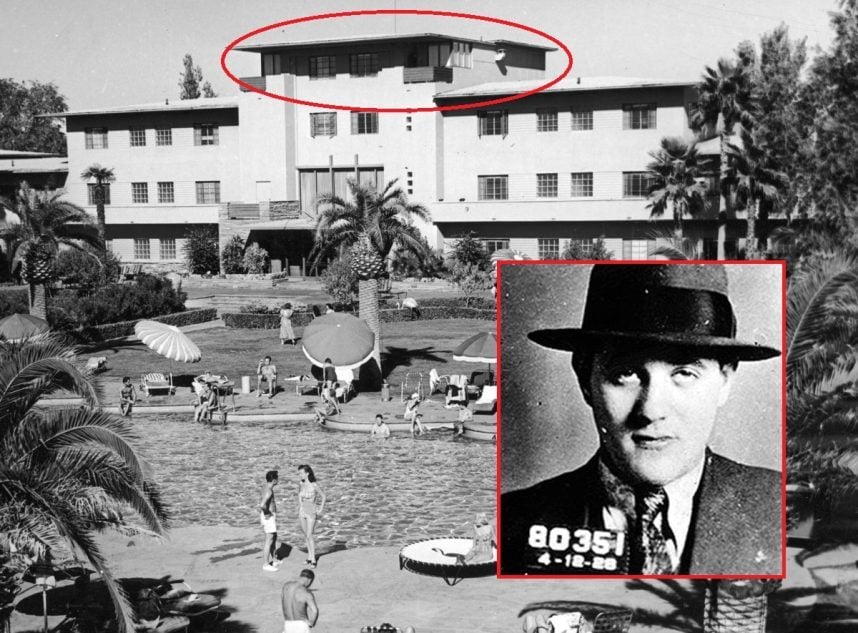
The Oregon Building housed Bugsy’s suite with a view of the pool, designated Room 44000. While we could elaborate on its extravagant features, the plaque left behind post-demolition conveys it perfectly…
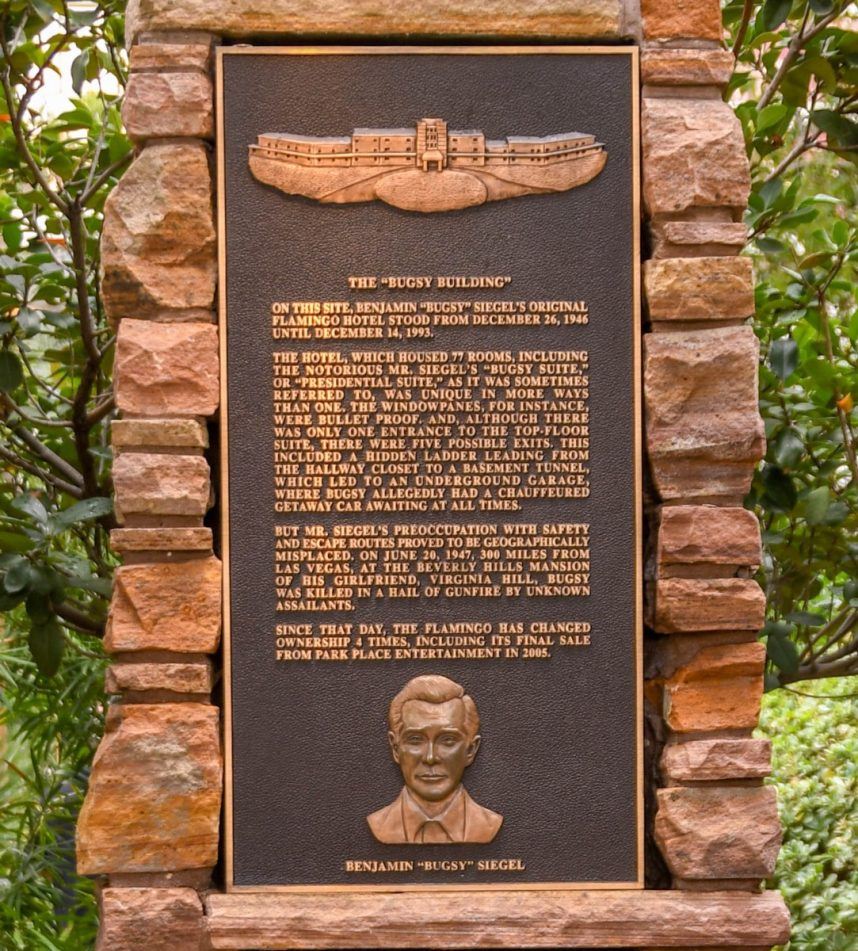
“Despite having a singular entry point to the suite, there were five potential escape routes,” it states. “Among these was a concealed ladder discreetly leading from the hallway closet to a basement tunnel, which connected to an underground garage where a chauffeur-driven vehicle was allegedly stationed for Bugsy’s escape at all times.”
So much for keeping secrets. The plaque further indicates that Siegel’s suite, also referred to as the presidential suite, included bulletproof windows.
With the benefit of hindsight, such measures weren’t merely paranoid.
A Narrative Pocked with Bullet Holes
The issue lies in the fact that not one of Siegel’s associates ever mentioned any escape tunnel at the Flamingo.
It’s conceivable that the countless individuals involved in the Oregon Building’s construction and maintenance managed to conceal its most talked-about clandestine feature for 47 years, even post-employment; however, a search through the 970 million pages on Newspaper.com reveals no references to “Bugsy Siegel” alongside “tunnel” until a 1992 piece by journalist Yardena Arar from the LA Daily News.
What a remarkable coincidence! The Warren Beatty film “Bugsy” was released just a year prior. Could it be that the Flamingo’s fifth proprietor, Hilton Hotels Corporation, saw this movie as a means to boost Bugsy tourism by fabricating this whole narrative?
During tours of the grounds while the Oregon Building still existed, patrons could enjoy the $14.95 “Bugsy’s Speakeasy Special” dinner at the Flamingo’s Beef Barron restaurant and were routinely “educated” about the suite’s alleged secrets.
Before the plaque’s installation in 1993 or 1994, some retellings included two getaway cars prepared for Bugsy, each facing in opposite directions for a 50/50 chance of fleeing gunfire.
The scenario seems like a wishful fantasy. Siegel could certainly have benefited from such an arrangement at the Beverly Hills residence of his girlfriend, Virginia Hill, on the night of June 20, 1947. Or, as the plaque chillingly notes: “Mr. Siegel’s fixation on security and escape routes proved to be geographically misguided.”
Decoding the Myth
Like many compelling myths, this one contains at least a kernel of truth.
The Civilian Production Administration (CPA), a temporary federal body overseeing non-war-related construction during the waning days of WWII and its immediate aftermath, initially approved the plans for the Flamingo’s construction, stipulating it as a single entity.
When the CPA noted the erection of three different wings in 1946, it mandated construction be halted.
The rationale behind this reversal is subject to reasonable speculation. Memoirs and secondary sources suggest that Bugsy adeptly persuaded the agency that tunnels linking the three hotel sections — designed to facilitate discreet transit for staff, VIP celebrities, and supplies — qualified the Flamingo as a unified structure.
However, the Oregon Building was a distinct, standalone structure intended for staff accommodations and ancillary lodging.
Vision of Tunnels
One of the most compelling indicators disputing the narrative is the absence of any reports from Hilton Hotels regarding the discovery of trapdoors or tunnels within the Oregon Building. A corporation that leveraged such a story would be eager to search for evidence to publicize.
Yet, we are led to believe that it valued this narrative to the extent of preemptively placing a plaque to validate it forever, while somehow neglecting to conduct a thorough examination of the suite whenever it pleased after acquiring the Flamingo in 1970.
Perhaps prior renovations concealed the trap door or tunnel.
Then why not uncover them, excavate, and document the remains? Surely, a documentary covering the venture would draw viewership! Executing this right before demolition would have spared Hilton Hotels any restoration costs for the suite!
There’s no better way to concur with this saga than to quote a line from “Bugsy,” where Hill remarks to Siegel…
“Dialogue is cheap in Hollywood, Ben.”
Catch “Vegas Myths Busted” each Monday on Casino.org. Click here for previous myth-busting articles about Vegas. Do you have a Vegas myth suggestion that requires investigation? Email [email protected].