


Published on: September 15, 2025, 07:55h.
Updated on: September 15, 2025, 09:53h.

- A former Washington state worker will serve 18 months in prison for embezzling nearly $900K to fuel his gambling habit.
- The presiding judge opted for leniency, acknowledging that addiction can lead to poor decisions even among respectable individuals.
A previous employee of the State of Washington has been sentenced to a year and a half in prison for wire fraud, stemming from an embezzlement scheme that siphoned nearly $900,000 to finance a serious gambling addiction.
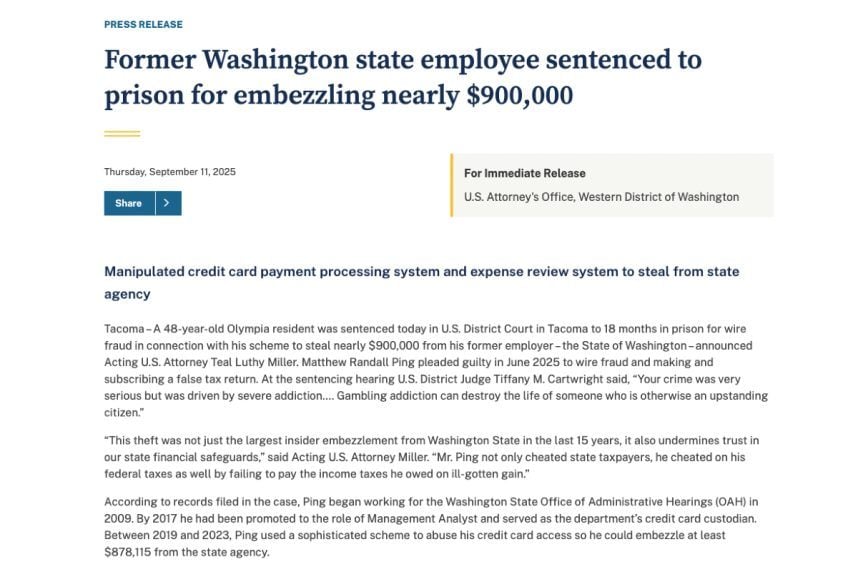
Matthew Randall Ping, 48, was prosecuted by the U.S. Attorney’s Office for the Western District of Washington after he stole $878,115 while serving as a management analyst at the Washington State Office of Administrative Hearings (OAH). Ping was responsible for managing the department’s credit cards.
Federal authorities claimed that Ping misused his access to the state’s credit cards, executing what was termed a “sophisticated scheme” to illegally extract funds amounting to “at least” $878,115 from the state agency. In June, Ping accepted a plea agreement, confessing to law enforcement about his severe gambling addiction.
“Your actions are grave, but they stem from a significant addiction. Gambling addiction can devastate the life of an otherwise respectable person,” stated U.S. District Judge Tiffany Cartwright.
Cartwright ultimately sentenced Ping to 18 months for wire fraud and filing a false tax return. Prosecutors initially sought a sentence of 33 months.
Claims of Limited Support for Addicts
Ping acknowledged that he opened multiple payment processing accounts with names imitating legitimate vendors of the OAH.
Between 2019 and 2021, financial records indicated that he illicitly charged hundreds of thousands of dollars to these accounts, which he then withdrew to finance his gambling pursuits. Prosecutors revealed that he took at least six trips to Las Vegas.
“He misappropriated taxpayer funds to sustain his gambling habits, covering the costs of at least six trips to Las Vegas, paying off a luxury car loan, and supporting his lifestyle. Furthermore, he neglected to report any of the income from his criminal activities on his federal tax returns, leading to a tax deficit of nearly $250,000,” Assistant U.S. Attorney Dane Westermeyer noted, advocating for a stiffer sentence.
Ping informed the court that he sought assistance for his gambling addiction, but found “resources for help are severely limited.”
Upon completion of his 18-month prison term, Ping will face three years of supervised release. Judge Cartwright mandated that he engage in “advocacy for services and regulations that would aid individuals struggling with gambling addiction.”
Ping committed to full restitution to the state, its insurance provider, and the IRS, totaling an obligation of $1,118,362.
Gambling Addiction Support Resources
Ping contended that assistance for gambling addiction is scarce.
Every state with legal gambling — and some without — provides resources for those struggling with gambling issues. A great starting point for anyone seeking help for themselves or a loved one is the National Council on Problem Gambling’s helpline at 1-800-GAMBLER or their website at 1-800-GAMBLER.
The NCPG serves as a national hub for problem gambling, offering 24/7 support, 365 days a year, to assist problem gamblers or those looking for more information. Reaching out to 1-800-GAMBLER is both confidential and anonymous.