


Published on: April 9, 2026, at 11:49 AM.
Updated on: April 9, 2026, at 11:49 AM.

- Former President Trump is scheduled to arrive in Las Vegas on April 19
- His visit follows the federal Tax Day
- Trump aims to advocate for his No Tax on Tips initiative
Next week, former President Donald Trump will journey to Las Vegas with plans to support his “No Tax on Tips” campaign at a rally to be announced in Southern Nevada.
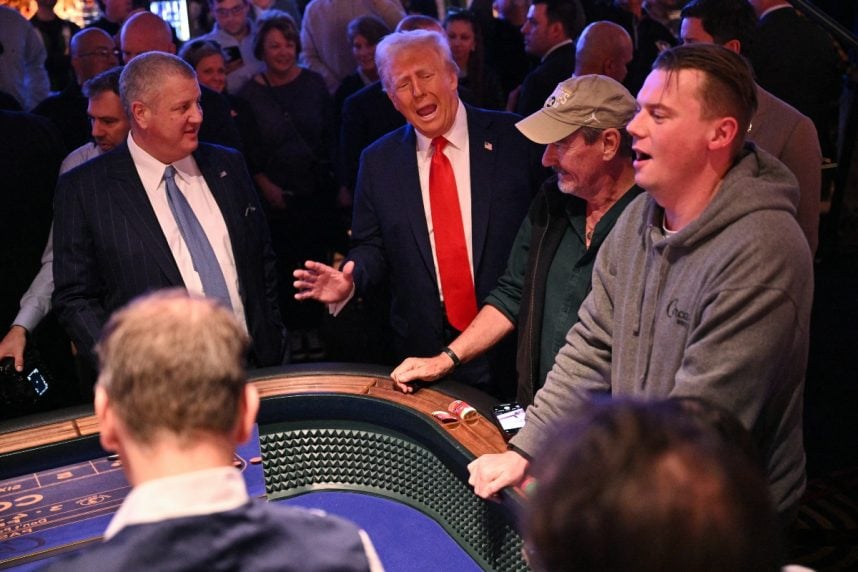
Trump’s appearance is arranged for Thursday, April 16, just a day after the IRS’s federal tax filing deadline.
He will focus on how the One Big Beautiful Bill (OBBB) will assist casino and hospitality staff across the nation by decreasing their federal tax responsibilities on tips. Beginning in 2026, the GOP tax plan will permit tipped workers to deduct up to $25,000 of their tip income from federal taxes.
“Next week, you’ll hear President Trump crediting his policies for helping American citizens. I am delighted to announce he will be visiting Nevada and Arizona to highlight this momentous achievement,” remarked White House Press Secretary Karoline Leavitt.
The OBBB has established the tip deduction measure for the 2026 tax year, continuing at least through 2028, pending congressional extension.
No Tax on Tips Initiative
Eliminating federal taxes on a worker’s initial $25,000 in tips received positive reception, even from critics like the Culinary Union, the major trade organization for casino employees in the U.S. This support is significant in light of a challenging 2025 year for Las Vegas, marked by a 7.5% decline in visitors.
In early 2025, during a visit to Circa Resort & Casino, Trump promoted the no tax on tips commitment.
“If you work in a restaurant, as a server, valet, bellhop, bartender, or even one of my caddies—I go through caddies like candy—your tips will be entirely yours,” Trump stated.
Another OBBB Tax Provision Impacting Gamblers
A significant aspect of the OBBB impacting the gaming sector entails changes that could jeopardize the revenue for Nevada and other gambling states, as it curtails the permissible deductions for losses reported on itemized federal tax returns.
The GOP tax reform has reduced the deductible gambling losses against winnings from 100% to 90%. This adjustment signifies that a gambler who earns $100,000 and also suffers losses of $100,000 will still incur federal taxes on $10,000 of fictitious income.
Previously, the gambling deduction allowed both casual and professional gamblers to offset their losses against wins, akin to how businesses deduct expenses from revenue. Congress members Rep. Dina Titus (D-NV) and Sen. Catherine Cortez Masto (D-NV) have introduced bills aiming to revert the gambling loss deduction back to its previous rate of 100%.
“When @POTUS visits Nevada next week to discuss taxes, we should urge him to correct the 90% gambling loss deduction,” wrote Titus on X.
Titus’ FAIR Bet Act seeks to allow taxpayers to deduct 100% of their gambling losses against their winnings. Should it pass, this legislation could take effect retroactively from the start of 2026. Cortez Masto is advocating for a similar proposal named the FULL House Act.
Supporters of maintaining the 90% cap on gambling losses argue that gambling is simply entertainment and expenses in this arena should not be deductible.
“Some might contend that if gambling winnings are subject to taxation, equity necessitates allowing loss offsets, akin to stock losses or other investments. However, the tax code already denies deductions for income-generating endeavors when mixed with personal consumption, such as treating a client to a Broadway show. Consistency demands the rejection of the gambling loss deduction,” stated Mirit Eyal-Cohen, Joseph D. Peeler Professor of Law at the University of Alabama School of Law, alongside Jay Soled, Distinguished Professor of Taxation at Rutgers Business School, in a recent op-ed published in The Hill.