


Published on: May 8, 2026, 05:06h.
Updated on: May 8, 2026, 05:06h.

- A federal investigation has identified the presence of the brain-eating amoeba in various sites within the Lake Mead National Recreation Area, encompassing well-known hot springs and swimming destinations.
- While this amoeba is a naturally occurring species found in many areas, the likelihood of infection is minimal and typically happens when contaminated water enters the nasal passages.
- Although health authorities have not released new alerts, they advise swimmers to consider using nose clips and to refrain from disturbing sediment in warm, shallow freshwater.
A recent federal investigation has uncovered the presence of Naegleria fowleri, commonly referred to as the “brain-eating amoeba,” in several U.S. national parks, including the popular recreational area of Lake Mead close to Las Vegas. The study, published in the journal ACS EST Water, broadens the documented range of this organism but does not prompt any new federal advisories.

Naegleria fowleri is a microscopic entity thriving in warm freshwater bodies, such as lakes, rivers, and hot springs. Infections occur exclusively when contaminated water enters through the nose, allowing the amoeba to ascend to the brain and result in primary amoebic meningoencephalitis (PAM), an uncommon but frequently fatal illness.
This organism does not pose a risk through drinking water.
Initial symptoms typically include headache, fever, and nausea, which can escalate to confusion, seizures, and coma. The Centers for Disease Control and Prevention reports that fatalities usually arise within five days of the first symptoms, although the onset can range from one to 18 days. From 1962 to 2024, there were 167 reported cases in the U.S., with only four individuals surviving.
Health experts assert that while the general public’s risk is extremely low, it is not completely absent.
Research Methodology
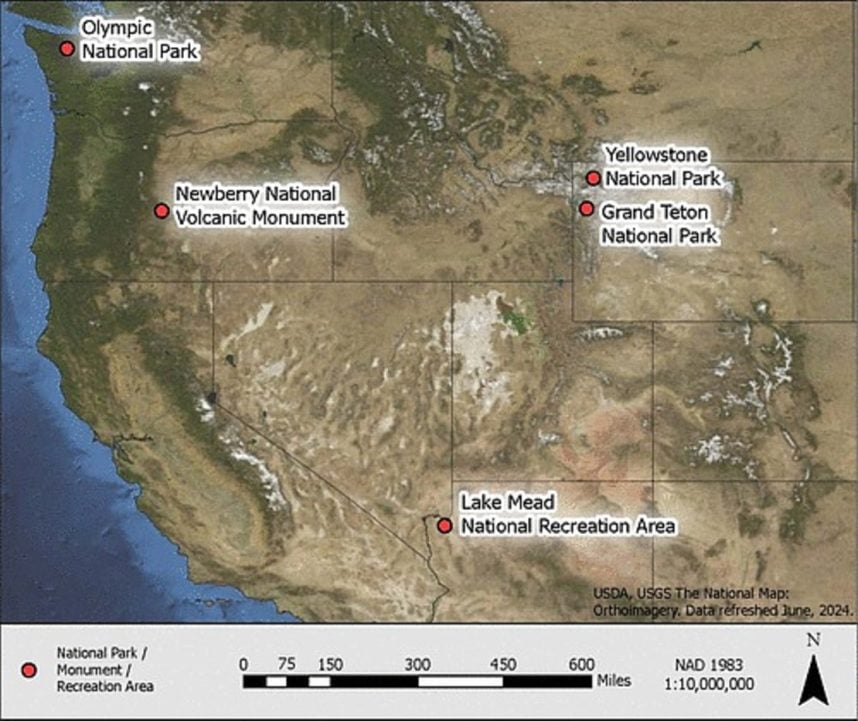
The new research analyzed a total of 185 water samples collected from five areas: Lake Mead National Recreation Area, Yellowstone National Park, Grand Teton National Park, Olympic National Park, and Newberry National Volcanic Monument.
Naegleria fowleri was identified in 34% of the samples, with concentrations ranging from 4.9 to 115.7 cells. The amoeba was located across a variety of temperatures, from 63.9°F to 130.9°F, and pH levels between 5.0 and 8.4. The specific detection sites included:
- Lake Mead: Blue Point, Boy Scout, Nevada Hot Springs, and Rogers Hot Springs
- Yellowstone: Firehole River, Boiling River, Lewis Lake Hot Springs
- Grand Teton: Polecat Hot Springs, Huckleberry Hot Springs
Researchers clarified that these findings do not signify an outbreak. Rather, they indicate that Naegleria fowleri is more prevalent than previously acknowledged.
This amoeba is already known to inhabit various regions throughout the U.S., especially in southern states. Experts anticipate that while cases will remain rare, rising water temperatures may expand the habitats suitable for the organism.
At Lake Mead, the National Park Service has not implemented new safety advisories beyond their usual recommendations.
State health entities, including the Utah Department of Health and Human Services, advise minimizing water entry into the nose during warm freshwater activities. Using nose clips can help reduce exposure, and officials suggest avoiding actions that disturb sediment in shallow, warm regions where the amoeba may be more concentrated.
While PAM is one of the most uncommon infectious diseases in the U.S., the study’s authors stress the need for awareness, particularly among individuals who swim in warm freshwater or utilize natural hot springs. Health officials assert that the risk remains extremely low, but simple actions can further decrease exposure chances.