


Published on: May 21, 2026, 07:06h.
Updated on: May 21, 2026, 07:06h.

- A Senate subcommittee conducted a hearing on prediction markets on Wednesday
- The gaming sector is against sports trading on prediction markets
On Wednesday, the US gaming industry presented its case to Congress asserting that federally sanctioned prediction markets should be prohibited from offering sports trading.
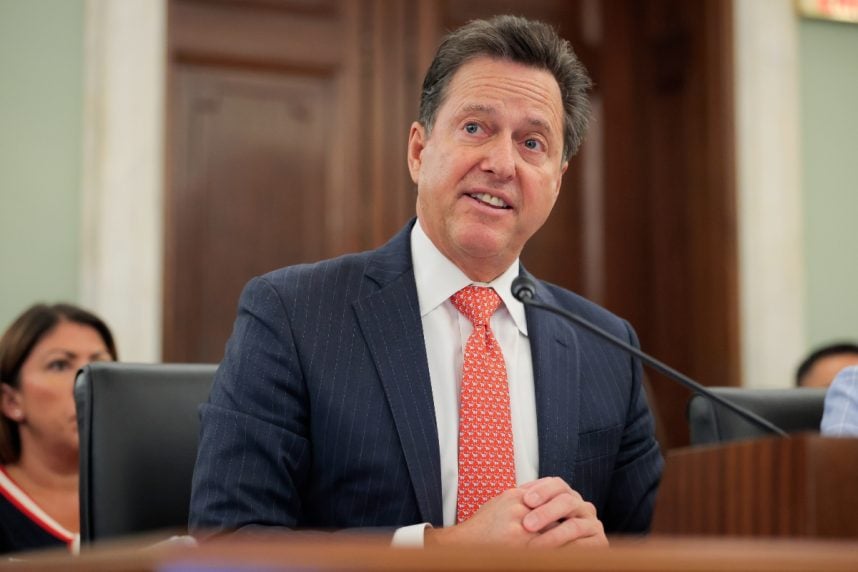
While addressing the Senate Subcommittee on Consumer Protection, Technology, and Data Privacy, Bill Miller expressed that prediction markets like Kalshi and Polymarket are functioning as “backdoor sports betting operations.” Miller emphasized that these services “undermine the expertise of 8,400 industry regulators, as well as the consumer protections embedded in state and tribal laws, and the will of voters across the nation.”
During the second term of the Trump administration, the Commodity Futures Trading Commission (CFTC), responsible for oversight of prediction markets, has welcomed the lawful innovation of new event contracts on speculative exchanges. Last year, prediction markets began trading on the outcomes of sports events, which the CFTC asserts falls under financial investment activity.
AGA: Prediction Markets Equate to Sports Betting
Miller stated in his testimony that contracts based on sporting events available through prediction markets amount to sports betting.
“These products operate as sports betting in every crucial aspect. Consumers wager money on the outcomes of sporting events and player performances. Sports betting is being rebranded as a financial product that bypasses essential consumer protections, responsible gaming standards, and state and tribal regulatory frameworks,” Miller asserted.
Dr. Harry Levant, the director of gambling policy at the Public Health Advocacy Institute, concurred with Miller’s views.
“Sports prediction markets fit the widely accepted and straightforward definition of gambling. Sports gambling involves betting or staking a valued item, with an understanding of risk and the hope of gain, based on the outcomes of games, contests, or uncertain events that may be resolved by chance,” Levant stated during the hearing.
Levant, who has a history of gambling addiction that led him to steal nearly $2 million from clients at his law firm, also highlighted the consumer dangers posed by Congress potentially allowing the CFTC to authorize sports contracts within prediction markets.
“Prediction markets that provide sports futures contracts put forth the well-known addictive nature of gambling to the public in a heightening risky format,” Levant added.
Most states permitting legal sports betting have a minimum gambling age of 21, though states like Kentucky, Montana, New Hampshire, Rhode Island, Wyoming, and Washington, DC allow those 18 and older to participate. In contrast, prediction markets operate under an 18+ age requirement nationwide.
Pro Prediction Markets Advocates
The hearing also featured viewpoints from advocates for prediction markets. Patrick McHenry, a former US representative from North Carolina and past chair of the House Financial Services Committee, disputed the notion that sports trades within prediction markets are analogous to sports betting.
“Sportsbooks and prediction markets represent fundamentally distinct products,” asserted McHenry, who currently advocates for the Coalition for Prediction Markets.
“In a sportsbook, the house dictates the odds and profits when customers incur losses. In contrast, a prediction market leverages participant trading with one another, while the platform derives revenue from transaction fees for facilitating the market. Consequently, the incentives are inherently different,” McHenry explained.
Further Hearings Anticipated
Key topics during the hearing revolved around whether sports trading on prediction markets should be permitted, if such contracts jeopardize the integrity of sports, and whether Congress and/or the CFTC needs to intervene more decisively to thwart insider trading on these platforms.
Committee Chair Marsha Blackburn (R-Tenn.) indicated that this gathering might be the first of several future discussions concerning the regulatory framework for prediction markets.