


Published on: May 22, 2026, at 03:26h.
Updated on: May 22, 2026, at 03:26h.

- Dan Keene named new CEO of Alberta iGaming Corporation
- Keene addressed his new position at this week’s gaming summit in Toronto
- Keene announces Alberta’s collaboration with Ontario on interprovincial liquidity
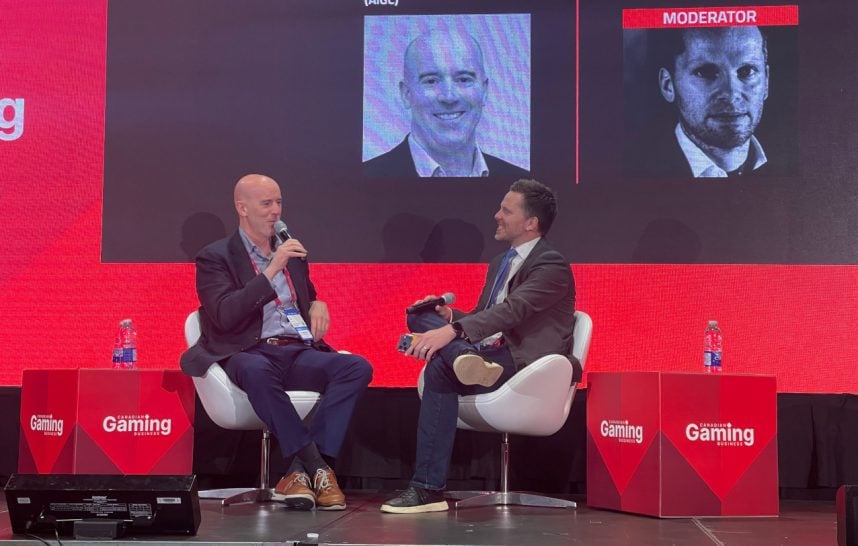
Dan Keene, previously the interim CEO of the Alberta iGaming Corporation (AiGC), has now been confirmed as the permanent CEO. One of his first statements during the SBC Summit Canada was regarding the ongoing efforts to create a memorandum of understanding (MOU) with Ontario to streamline interprovincial liquidity.
MOU With Ontario
During a discussion with gambling expert Martin Lycka, Keene announced the initiative.
“We aim to finalize [liquidity] with our colleagues in Ontario as swiftly as we can,” stated Keene. “We fully support this collaboration.”
Keene’s official tenure begins as Alberta is set to launch its regulated iGaming market on July 13. Alberta’s Minister of Service Alberta and Red Tape Reduction, Dale Nally, shared that 37 operators have completed their registration for the government-owned Play Alberta platform, while 70 more have expressed interest in joining.
International Liquidity in the Courts
The Alberta iGaming regulatory framework assigns Alberta Gaming, Liquor & Cannabis as the overseeing authority for registrations and regulation, while AiGC is responsible for managing commercial agreements, anti-money laundering protocols, public complaints, and financial reporting.
Operators are likely to welcome the MOU between AiGC and the Alcohol and Gaming Commission of Ontario (AGCO), as it would enlarge the player pool available to operators in both provinces, facilitating larger tournaments and a more robust ecosystem which can effectively compete with international grey market platforms.
Since the launch of Ontario’s regulated market in April 2022, operators have faced challenges in migrating players to Ontario-specific platforms.
Collaboration With Ontario
Poker heavily relies on liquidity.
A pivotal ruling by the Ontario Court of Appeal last November, in a 4-1 decision, confirmed that the province’s regulated iGaming setup could permit international pooled liquidity, enabling Ontario players to engage in peer-to-peer online gaming, such as poker and daily fantasy sports (DFS), with users outside of Canada.
Some provincial lottery bodies have contested this ruling, fearing it could disrupt the geographical constraints traditionally governing provincially run gaming frameworks. The case is now escalated to the Supreme Court of Canada.
Alberta has also positioned itself as an intervenor in this case regarding international liquidity.
Supreme Court Proceedings
“Our stance is one of support for international liquidity,” he remarked. “From a business perspective, this is undoubtedly beneficial.”
In his conversation with Lycka, Keene highlighted the distinctions between Alberta’s and Ontario’s iGaming regulations.
“We’re not attempting to reinvent the wheel unnecessarily,” he stated. “Ontario has already set a strong foundation. We are leveraging successful strategies shared by Ontario to meet our July 13 launch date.”
80/20 Revenue Division With the Government
A point of alignment with Ontario includes a partnership with the Responsible Gambling Council, as the RG Check accreditation process required for operators in Ontario will be a crucial element for Alberta’s approach as well.
A notable difference lies in the tax distribution between operators and the government. Ontario retains a direct 20% cut of revenue. In Alberta, while the split also favors an 80/20 division, a 3% portion will first be allocated for responsible gambling efforts and First Nations initiatives.
Keene emphasized the importance of responsible gambling for Alberta. A centralized self-exclusion platform is set to launch alongside the market on July 13. In contrast, Ontario introduced its centralized self-exclusion system earlier this month, over four years post-regulated market launch.
Commitment to Responsible Gambling
“We are implementing several initiatives to promote responsible gaming,” asserted Keene. “It’s not only a moral obligation but also essential for our operations. Gambling should be viewed as a form of entertainment, not a revenue source.
“We must be proactive in our approach, collaborating with the Responsible Gambling Council and AGLC, to prioritize player safety before issues arise.”